
“I Am An African” ~ Thabo Mbeki
Thabo Mvuyelwa Mbeki, the second president of South Africa [June 1999 – September 2008], delivered this self-penned speech entitled “I Am an African” on May 8th, 1996. During this time Mbeki was serving as Vice President of South Africa under Nelson Mandela’s post-Apartheid Presidency. The occasion was the passing of the new Constitution of South Africa. VP Mbeki’s speech, delivered on behalf of the African National Congress, captured the political mood of the moment in South Africa:
I am an African.
I owe my being to the hills and the valleys, the mountains and the glades, the rivers, the deserts, the trees, the flowers, the seas and the ever-changing seasons that define the face of our native land.
My body has frozen in our frosts and in our latter-day snows. It has thawed in the warmth of our sunshine and melted in the heat of the midday sun. The crack and the rumble of the summer thunders, lashed by startling lightning, have been a cause both of trembling and of hope.
The fragrances of nature have been as pleasant to us as the sight of the wild blooms of the citizens of the veld.
The dramatic shapes of the Drakensberg, the soil-coloured waters of the Lekoa, iGqili noThukela, and the sands of the Kgalagadi, have all been panels of the set on the natural stage on which we act out the foolish deeds of the theatre of the day.
At times, and in fear, I have wondered whether I should concede equal citizenship of our country to the leopard and the lion, the elephant and the springbok, the hyena, the black mamba and the pestilential mosquito.
A human presence among all of these, a feature on the face of our native land thus defined, I know that none dare challenge me when I say – I am an African!
I owe my being to the Khoi and the San whose desolate souls haunt the great expanses of the beautiful Cape – they who fell victim to the most merciless genocide our native land has ever seen, they who were the first to lose their lives in the struggle to defend our freedom and independence and they who, as a people, perished in the result.
Today, as a country, we keep an inaudible and audible silence about these ancestors of the generations that live, fearful to admit the horror of a former deed, seeking to obliterate from our memories a cruel occurrence which, in its remembering, should teach us not and never to be inhuman again.
I am formed of the migrants who left Europe to find a new home on our native land. Whatever their own actions, they remain still part of me.
In my veins courses the blood of the Malay slaves who came from the East. Their proud dignity informs my bearing, their culture a part of my essence. The stripes they bore on their bodies from the lash of the slave master are a reminder embossed on my consciousness of what should not be done.
 I am the grandchild of the warrior men and women that Hintsa and Sekhukhune led, the patriots that Cetshwayo and Mphephu took to battle, the soldiers Moshoeshoe and Ngungunyane taught never to dishonour the cause of freedom.
My mind and my knowledge of myself is formed by the victories that are the jewels in our African crown, the victories we earned from Isandhlwana to Khartoum, as Ethiopians and as Ashanti of Ghana, as Berbers of the desert.
I am the grandchild who lays fresh flowers on the Boer graves at St Helena, The Bahamas, and the Vrouemonument, who sees in the mind’s eye and suffers the suffering of a simple peasant folk, death, concentration camps, destroyed homesteads, a dream in ruins.
I am the child of Nongqawuse. I am he who made it possible to trade in the world markets in diamonds, in gold, in the same food for which our stomachs yearn.
I come of those who were transported from India and China, whose being resided in the fact, solely, that they were able to provide physical labour, who taught me that we could both be at home and be foreign, who taught me that human existence itself demanded that freedom was a necessary condition for that human existence.
Being part of all of these people, and in the knowledge that none dares contest that assertion, I shall claim that – I am an African.
I have seen our country torn asunder as these, all of whom are my people, engaged one another in a titanic battle, the one to redress a wrong that had been caused by one to another and the other, to defend the indefensible.
I have seen what happens when one person has superiority of force over another, when the stronger appropriate to themselves the prerogative even to annul the injunction that God created all men and women in His image.
I know what it signifies when race and colour are used to determine who is human and who, sub-human.
I have seen the destruction of all sense of self-esteem, the consequent striving to be what one is not, simply to acquire some of the benefits which those who had imposed themselves as masters had ensured that they enjoy.
I have experience of the situation in which race and colour is used to enrich some and impoverish the rest.
I have seen the corruption of minds and souls as a result of the pursuit of an ignoble effort to perpetrate a veritable crime against humanity.
I have seen concrete expression of the denial of the dignity of a human being emanating from the conscious, systemic and systematic oppressive and repressive activities of other human beings.
There the victims parade with no mask to hide the brutish reality – the beggars, the prostitutes, the street children, those who seek solace in substance abuse, those who have to steal to assuage hunger, those who have to lose their sanity because to be sane is to invite pain.
Perhaps the worst among these, who are my people, are those who have learnt to kill for a wage.  To these the extent of death is directly proportional to their personal welfare.
And so, like pawns in the service of demented souls, they kill in furtherance of the political violence in KwaZulu-Natal. They murder the innocent in the taxi wars.
They kill slowly or quickly in order to make profits from the illegal trade in narcotics. They are available for hire when husband wants to murder wife and wife, husband.
Among us prowl the products of our immoral and amoral past – killers who have no sense of the worth of human life, rapists who have absolute disdain for the women of our country, animals who would seek to benefit from the vulnerability of the children, the disabled, and the old, the rapacious who brook no obstacle in their quest for self-enrichment.
All this I know and know to be true because I am an African!
Because of that, I am also able to state this fundamental truth that I am born of a people who are heroes and heroines.
I am born of a people who would not tolerate oppression.
I am of a nation that would not allow that fear of death, of torture, of imprisonment, of exile or persecution should result in the perpetuation of injustice.
The great masses who are our mother and father will not permit that the behaviour of the few results in the description of our country and people as barbaric.
Patient because history is on their side, these masses do not despair because today the weather is bad. Nor do they turn triumphalist when, tomorrow, the sun shines.
Whatever the circumstances they have lived through and because of that experience, they are determined to define for themselves who they are and who they should be.
We are assembled here today to mark their victory in acquiring and exercising their right to formulate their own definition of what it means to be African.
The Constitution whose adoption we celebrate constitutes an unequivocal statement that we refuse to accept that our African-ness shall be defined by our race, our colour, our gender or our historical origins.
 It is a firm assertion made by ourselves that South Africa belongs to all who live in it, Black and White.
It gives concrete expression to the sentiment we share as Africans, and will defend to the death, that the people shall govern.
It recognises the fact that the dignity of the individual is both an objective which society must pursue, and is a goal which cannot be separated from the material well-being of that individual.
It seeks to create the situation in which all our people shall be free from fear, including the fear of the oppression of one national group by another, the fear of the disempowerment of one social echelon by another, the fear of the use of state power to deny anybody their fundamental human rights and the fear of tyranny.
It aims to open the doors so that those who were disadvantaged can assume their place in society as equals with their fellow human beings without regards to colour, to race, to gender, to age or to geographic dispersal.
 It provides the opportunity to enable each one and all to state their views, to promote them, to strive for their implementation in the process of governance without fear that a contrary view will be met with repression.
It creates a law-governed society which shall be inimical to arbitrary rule.
It enables the resolution of conflicts by peaceful means rather than resort to force.
It rejoices in the diversity of our people and creates the space for all of us voluntarily to define ourselves as one people.
 As an African, this is an achievement of which I am proud, proud without reservation and proud without any feeling of conceit.
Our sense of elevation at this moment also derives from the fact that this magnificent product is the unique creation of African hands and African minds.
But it also constitutes a tribute to our loss of vanity that we could, despite the temptation to treat ourselves as an exceptional fragment of humanity, draw on the accumulated experience and wisdom of all humankind, to define for ourselves what we want to be.
Together with the best in the world, we too are prone to pettiness, to petulance, selfishness and short-sightedness.
But it seems to have happened that we looked at ourselves and said the time had come that we make a super-human effort to be other than human, to respond to the call to create for ourselves a glorious future, to remind ourselves of the Latin saying: Gloria est consequenda – Glory must be sought after.
Today it feels good to be an African.
It feels good that I can stand here as a South African and as a foot soldier of a titanic African army, the African National Congress, to say to all the parties represented here, to the millions who made an input into the processes we are concluding, to our outstanding compatriots who have presided over the birth of our founding document, to the negotiators who pitted their wits one against the other, to the unseen stars who shone unseen as the management and administration of the Constitutional Assembly, the advisers, the experts and the publicists, to the mass communication media, to our friends across the globe – congratulations and well done!
 I am an African.
I am born of the peoples of the continent of Africa.
The pain of the violent conflict that the peoples of Liberia, and of Somalia, of the Sudan, of Burundi and Algeria is a pain I also bear.
The dismal shame of poverty, suffering and human degradation of my continent is a blight that we share.
The blight on our happiness that derives from this and from our drift to the periphery of the ordering of human affairs leaves us in a persistent shadow of despair.
This is a savage road to which nobody should be condemned. The evolution of humanity says that Africa reaffirms that she is continuing her rise from the ashes.
 Whatever the setbacks of the moment, nothing can stop us now! Whatever the difficulties, Africa shall be at peace!
Thank you very much.
Ancestral Timeline: 12/21/12
 For years, many prophesied that December 21st, 2012 (12/21/12) on the western Gregorian calendar would usher in the biblically-forecast time of the Apocalypse (‘lifting of the veil’), because this date marked the end of the Mesoamerican Long Count calendar cycle of 5,126 years.
  New Age thinkers seized on this date as marking the end of the Age of Pisces (aka the Christian or Common Era – CE) and the beginning of the Aquarian Age (aka the Golden Era); the transition between the two characterized by an “End Times” season of cataclysm and transformation. Festivities commemorating the December 21st, 2012 event took place at Chichén Itzá in Mexico, Tikal in Guatemala, and other Maya civilization countries such as Honduras and El Salvador.
Today (in 2020) is 12/21/12 in the Horn of Africa [see calendar conversion link]. Comprising the countries of Ethiopia, Eritrea, Somalia, and Djibouti, the Horn of Africa is so named because the map of Africa’s easternmost extension resembles the profile of a rhinoceros horn. The name “Maya” in the Ethiopian Semitic language of Amharic means “a lens that helps to see further.”  Given the tumultuous events that are unfolding in this Gregorian calendar year of 2020, perhaps the 12/21/12 Mayan calendar prophecy is that lens which would help to further our seeing of this same date when interpreted on an ancestral African timeline. Time-space agendas, frequencies and eschatological beliefs attached to calculations of “2012” on the Gregorian-calendar have created a competing Eurocentric timeline…
  mainly to uphold the matrix created with stolen knowledge from ancient Egypt/Kemet.
“Know the world in yourself. Never look for yourself in the world, for this would be to project your illusion” [proverb from Ipet-Resyt – the southern sanctuary of Amun-Mut of ancient Egypt]. In Hindu mythology, “Maya” means illusion. The western Gregorian calendar which currently regulates most of the world’s affairs was introduced in 1582 CE by Roman-Catholic Pope Gregory XIII;  superseding the Julian calendar which had been implemented in Europe by Julius Caesar in 46 BCE. Both these and other calendars were revisions of and successors to the ancient Egyptian calendar as the Roman Empire gained in its control of space and time, constructing the threshold that brought humanity from “BC” to “AD” 2,020 years ago...
If hindsight is 20/20, perhaps the eschatological beliefs that failed to manifest the prophesied Apocalypse in 2012 was a revelation of “Maya” in the Hindu sense? After all, the Gregorian time-space narrative was constructed with Jesus in the starring role as humanity’s crucified savior whose return to earth was scripted as a triumphant and apocalyptic Second Coming. The image of Jesus – which was a central propaganda tool in this globally-proselytized Christian program – is said to have been modeled on Cesare Borgia, the “illegitimate” son of Pope Alexander VI. Jesus’ birth as God’s divine son was the purported fulfillment of Angel Gabriel’s announcement of Madonna Mary’s impending immaculate conception/virgin birth which justified pivoting the world from “BC” to “AD” on the Euro-patriarchal timeline. According to scholars of the Ethiopian timeline which is a sabbatical period “in arrears” of the upstart Gregorian one (saba in Kiswahili means “7”… also see sabbath) – though both trace back to ancient Egyptian calendrical calculations and ‘savior’ narratives, this Divine Birth-day creates the key point of divergence on the Africa-centered and matriarchal timeline…
Upon the inner walls of Ipet Resyt – “the southern sanctuary” built for God/dess consorts Amun’Re/Mut known today as the Luxor Temple in Egypt – lies the 1350 BCE origin of the biblical ‘Annunciation.’ According to John Anthony West [click picture for video: link @ 1:17:20], surrounding transcriptions of the communication depicted taking place between Amun’Re and his consort goddess Mut indicate that in this conversation Amun’Re is informing his beloved that she will give birth to a divine son/savior. Their conversation is furthermore linked to the ancient Mysteries of Ausar-Auset-Heru – aka the “Holy Trinity” – and their various challenges against the shadow, Set (predatory god of the wilderness, chaos, violence, foreign oppressors, illness, perversion…) aka biblical “Satan.”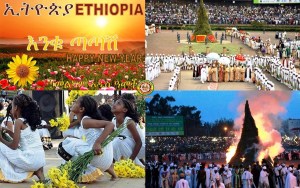
The Eritrean Orthodox Tewahedo Church in the Horn of Africa uses a calendar identical to the Ethiopian one for its liturgical year. On the Eritrean Ge’ez calendar, New Year is referred to as Ri’se Awde Amet (“Head Anniversary”). Enkutatash (“gift of jewels”) – the Amharic word for the Ethiopian New Year – occurs on September 11th of the Gregorian calendar, except for leap years [e.g. 2020] when it occurs on September 12th.  The Ethiopian Enkutatash tradition comes from a time when the Queen of the South (aka Makeda or Sheba) was showered with gifts of jewels (enku) upon her return from Jerusalem where, according to legend, she visited with King Solomon. This visit purportedly resulted in the Queen of Sheba’s pregnancy which began Africa’s Solomonic Dynasty.
In 1920, the Honorable Marcus Mosiah Garvey Jr. prophesied: “Look to Africa where a black king shall be crowned; he shall be your Redeemer.” Before declaring a man ‘King… Redeemer… Messiah… etc.,’ in African oral traditions, his would-be constituency will first “wait to see how he dances!”  For the Rastafari community in Garvey’s native Jamaica, the 1930 coronation of Haile Selassie of the Solomonic Dynasty as Emperor of Ethiopia – the sole African country to have ‘danced with the devil’ (Set) & resisted outright European colonization – was seen as a fulfillment of Garvey’s prophecy. Selassie was born Tafari Makonnen Woldemikael – hence the Ras-Tafari designation and belief in him as the prophesied messiah, Jah Rastafari aka Lion of the Tribe of Judah.
2019 (Gregorian) closed out a historical 400-year period of slavery… a biblical period [Genesis 15:13] that was noted in legislation and celebrations as an “End Times” of sorts… Africa’s “Year of Return.” 2020 has been epic and Apocalyptic in its challenge for human consciousness to ascend and rise out from under the veil – the predatory, elite-run 3D-matrix of containment [slavery… apartheid… colonialism…] called “Babylon” in Rastafari biblical reasoning and parlance. Such “Revelation” in BaNtu thought would return humanity to unity-conscious living under the traditional philosophy of “UbuNtu ~ I am, because we are…” A proverb from Ipet-Resyt (‘the southern sanctuary’ of God/dess consorts Amun’Re/Mut) instructs: “The kingdom of Heaven is already within you; if you understand yourself you will find it… As within, so without.” 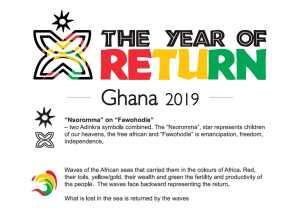 Euro-patriarchal appropriations of such ancestral wisdom, & their systemically racist institutional applications are being rejected globally in this current 2020 Apocalyptic season of revelation, judgment, & return… UbuNtu ❤ ❤ ❤ ❤
Emperor/Empress Lion-energy furthermore signifies the mastery of one’s life-lessons – bringing ’20/20′ clarity of the world within, & thus ending karmic cycles in the world without through those who do the necessary shadow-work that neutralizes Set and restores Heaven-on-Earth. In this regard it is fascinating to note that Tafari Makonnen Woldemikael – aka Emperor HaileSelassie aka Jah Rastafari aka Lion of the Tribe of Judah – was born on July 12th, 1892 and transitioned exactly 45 years ago today… on August 27th, 1975. Both dates straddle the astronomical Lions Gate [July 26th through August 12th] when examined with the Gregorian calendar-as-placeholder. According to the Horn of Africa’s Ancestral timeline and ancient Nile Valley Mysteries, today – August 27th, 2020 Gregorian – is the actual 12/21/12… ❤ ❤ ❤ ❤ Amun… ❤ ❤ ❤ ❤ May[a] we see further…

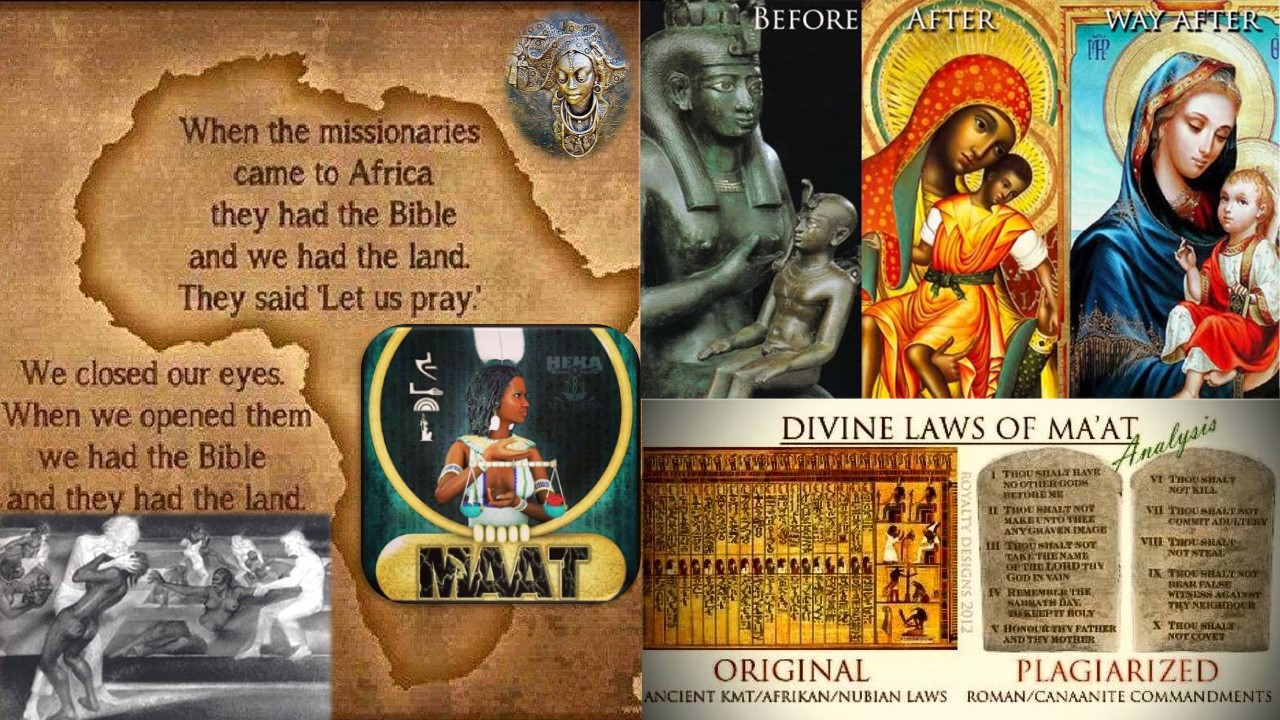


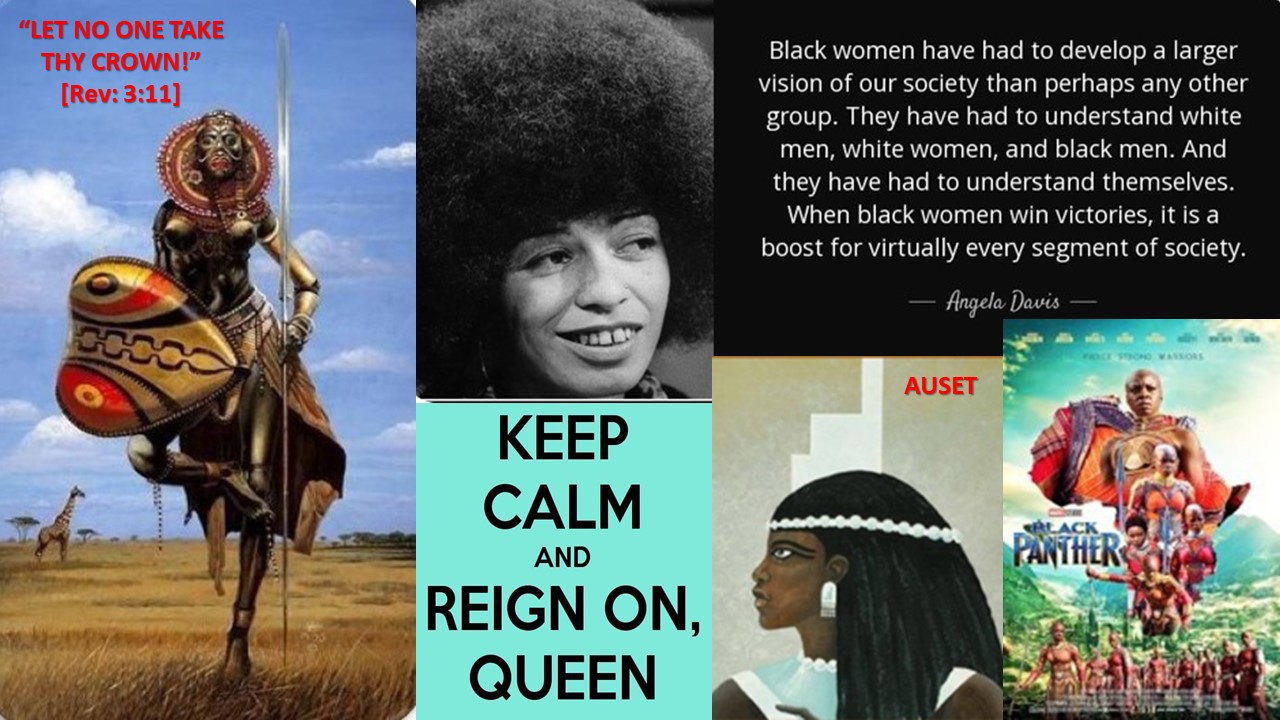

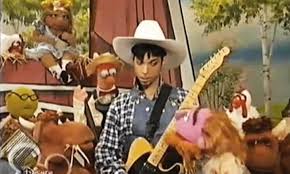
“She Gave Her Angels” ~ Prince
A song of adulation, love and fear
No one loved him better, no one better sacrificed
She gave her angels that summer night
Destiny and love don’t always go hand in hand (Hand in hand)
As the world lay waiting like an embryo in a womb
She gave her angels that night in June (She gave her angels)
To watch over him till she returned – her man, her lover, her son
Her father for all these things he meant to her, she felt it right
She gave her angels that summer night [Repeat: 2X]
- Songwriter/Artist: Prince Rogers Nelson (as
 )
) - First Released: 29 January 1998 – Crystal Ball album
- Fan Music Video by VDJ Vivacity …“This is a beautiful Prince song and definitely deserved a full music video beyond the snippet performed on Muppets Tonight.“ (LINK added by me 🙂 …SEE ‘She Gave Her Angels’ Muppets footage @ 17:42)
Mother Tree
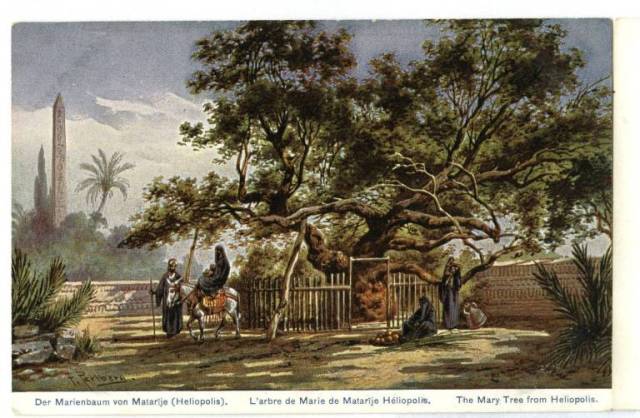 In no other place on earth were deities so closely associated with their trees as in ancient Egyptian mythology and eschatology, Trees of Life upon which an external god later attached “forbidden fruit” as his rationale for humanity’s exile from Eden. Trees in ancient Egypt were revered as sacred, and regarded as the organic dominion of ancient female sky deities whose role included facilitating the passage of the soul [ba] into the afterlife. The sycamore [nehet] became perhaps the most important of Egyptian sacred trees which include the date palm; acacia; and persea or ished tree.
  Although male deities were mythically connected to sacred trees and the wooden coffins that transported them to the afterlife, they were never identified with the trees themselves. Often planted near tombs, the sycamore represented the womb to which the departed were returned, sometimes in coffins made from the wood of this Mother Tree. Goddess Hathor and Nut in particular – as anthropomorphic Mother Trees – were depicted connecting the worlds: heaven/underworld… above/below… within/without… now/hereafter… Read More
When Doves Sing… Musings
 April 21st marks the anniversary of a day, four years ago, when Majesty and Divinity fell uncharacteristically silent. I learned about this after hearing their voices on a hauntingly beautiful music track that I’ve only recently discovered. I’d been drawn by the title of the track as I waxed nostalgic about the teenage version of me who’d walk several miles between my family home in Spring Valley to Kenya High during holidays just to play one of my school’s pianos for an hour or so. Granted that was less time than it had taken me to get there on foot, but I had the return trip to consider. Along the way, I’d pass by the Chiromo campus of the University of Nairobi where I’d always feel rejuvenated by the lush greens and natural habitation of the adjacent arboretum…
Arboretum, the moving piano piece in question that Prince recorded in his atrium at Paisley Park, is the 10th and final track on his 25th studio album entitled One Nite Alone… Released by NPG Records on May 14th 2002, Prince thoughtfully noted, “Ambient singing: the doves – Divinity and Majesty” in his Album Credits. Prince’s beloved pets are heard and warmly felt, presumably from their cage on the balcony overlooking Paisley Park’s sky-lit atrium as the artist performed & recorded his composition. At the end of Arboretum, the sound of heeled footsteps on an uncarpeted floor come through, painting an image on my mental screen of the artist walking away from his piano, perhaps retreating to a more personal recess of his creative complex that has now become a museum in suburban Minneapolis…
Chanhassen (said Minneapolis suburb) is a First Nation name in the Sioux language of the Dakota, meaning the tree with sweet sap – or sugar maple tree. Arboretum (trans: ‘botanical garden devoted to trees’), may well have been Prince’s musical alignment with & nod to the Minnesota city of his residence. Inspired by this thought, my memories meander between Nairobi Arboretum & western Kenya’s Kakamega Forest where I wasn’t an unfamiliar presence. I remember rhythmic singing suddenly breaking out from the perches of Red-eyed Doves (Columba semitorquata), which made me want to celebrate in dance each time. [Ref. Dove #2 in Lynette Rudman’s video below: #1: Tambourine Dove; #2: Red-eyed Dove; #3: Ring-necked Dove; #4: Mourning collared Dove; #5: Laughing Dove; #6: Emerald-spotted Wood Dove; #7: Namaqua Dove].
I’d like to imagine that my late father, a zoologist who specialized in the study of bats, would indulge my efforts to do due diligence to scientific inquiry [*ahem!]… albeit in service to these belated musings on the environs of Paisley Park and its mysterious, dove-loving nester. Speaking of which, in his first hit from Purple Rain – the 6th studio album that was released on June 25th, 1984 – Prince may creatively have been going for the ambience of Zenaida macroura [*cough!] – aka Mourning Doves. Now every time I hear the haunting and sad cooing sound for which this ubiquitous species is named, I think When Doves Cry…
Majesty and Divinity simply “stopped talking” after Prince crossed over, according to his sister Tyka in a 2016 Today show interview. Upon realizing this, Tyka instructed the Paisley Park staff to “play some Prince music” for his pet doves in order to help bring them out of their mournful silence. Just wow! Mother Nature’s collective consciousness is a font of endless fascination, particularly for me as a somewhat quirky expression from humanity’s African source. From his space in the diaspora, Prince was tapped into this same source on levels I’m only now beginning to appreciate. Beyond his music, there’s coded mystery in the architectural choices of the artist’s Paisley Park nesting and creative space that awaken my own epic memory. There are the pyramid skylights on the main building… the separate yet connected ‘Egg building’… and even the address itself…
…7801 Audubon Road is Paisley Park‘s street address which for me recalls renowned ornithologist John James Audubon. Born in Haiti in 1785, Audubon was noted for his paintings of birds, over 1,000 of which were documented in his book, Birds of America. The National Audubon Society was founded in his memory in 1886 to focus on the preservation and study of birds.
 But beyond their zoological details, birds are profoundly symbolic as winged messengers who navigate the skies and/or heavenly realms. Doves in particular symbolize love, hope, peace, gentleness, inner initiation, the Holy Spirit, eternal life… In the biblical Song of Songs there are several dove references in the communication between the Shulamite and her Beloved’s conjoined Spirit. One of the references that I visit time and again is: “His eyes are as the eyes of doves by the rivers of waters, washed with milk and fitly set” [SoS 5:12]. In the pre-biblical Auset-Ausar-Heru mythology of Kemet,
 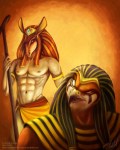 Goddess Hathor – “Lady of the Southern Sycamore” – used milk from Her sacred tree to restore sight to Heru after one of his epic battles against Set (usurper of Ausar’s heaven-on-earth throne). Heru – a precursor savior-figure and defender of his father Ausar’s throne (depicted as Auset’s crown) – is himself portrayed as a falcon-headed god. *******
“ARBORETUM”… The messages that a gently-played piano and a well-placed mic cause my quirky African ears to hear in 5D+… The ambient coo-ing of Majesty and Divinity, who raise homing frequencies into realms that cloak ascended masters from far too many robotic eyes & ears… “Don’t get lost in the forest,” Mother Tree entreats, long after his retreating footsteps have become silent… He ventures forth with the sweet sap of other trees which cause 3rd-eyes to open & soulful consciousness to reign like Purple… “Yo Twenny/Twenny, W’sup!? DJs R droppin’ beats like mad Grand Mixers @ homie’s joint. We jumpin’ time-lines… 2012 Party Override!”
If I could be the Red-eyed Dove’s lyricist during these roller-coaster times, my words to its rhythmic song would be: “I. Am! B’Cuz? …We. Rrrr!” Nothing fancy. Just a cultural mantra that takes me back to Mother Nature’s embrace & the free-quency of the great “I AM.” Throw some dance-floor swag up in that Song of Songs, like back in the day 😉 Old-School-style...UbuNtu, the guiding narrative of our 5D+ uni-verse: “I Am because We are!” In order to move forward on our S/Hero Journey, Sankofa adds that: we must first recover & reclaim that which was forgotten ,
, lost or stolen. ❤ ❤ ❤ So Keep Your Vibrations High, Dearly Beloved ❤ Don’t let ‘the elevator bring us down’ ❤ Know that U R Majestic and Divine ❤ Let no one take Thy Crown [Rev. 3:11] ❤ ❤ ❤
When & Where I Enter
 “Only the black woman can say ‘when and where I enter, in the quiet, undisputed dignity of my womanhood, without violence and without suing or special patronage, then and there the whole …race enters with me.’” [Anna J. Cooper, 1892] Dr. Anna Julia Cooper was born into slavery on August 10th, 1858 [d. 2/27/1964]. An activist during her life, Cooper triumphed over race and gender barriers to become a prominent scholar, educator, author, sociologist, and speaker. She received her education at St. Augustine’s University (NC), Oberlin College (OH), Columbia University (NY), and the University of Paris (Sorbonne) where, in 1924, Cooper became the 4th African-American woman to earn a doctorate with her Ph.D. in history. Author of the 1892 book A Voice from the South, which became a classic black feminist text, Cooper is often referred to as the Mother… or Matriarch of Black Womanism. Read More
“I Am a Black Man” ~ George Tait (poem)
Andreas Woods aka Kwaw Imana, the mathematics-major Morehouse class of 2000 Valedictorian who would go on to get a Ph.D. in Egyptology, used this moment in the Morehouse spotlight to explain why he rejected the Cecil Rhodes Scholarship for himself. Morehouse is an all-male HBCU. Rhodes’ legacy is that of an avowed white supremacist, reported pedophile, architect of apartheid, & agent of other colonial chaos in Afrika [i.e. ‘Set’ of Kemetic mythology]. Rhodes remains buried in Zimbabwe [colonial ‘Rhodesia’] since his death in 1902, while Britain erected an altar to Rhodes in the form of his statue at Oxford University in 1934! Reciting a poem by George Tait entitled I Am A Black Man, Kwaw Andreas Woods Imana – like Heru [‘Horus/Hero’] in Kemetic mythology – aligns the struggle of Afrika-descended manhood against the knowledge industry’s role in codifying and becoming politically complicit in upholding systemic racism and all of its ills. #RhodesMustFall Read More
Messages in Maps… [re-post]
[CLICK TITLE BELOW TO LINK TO ORIGINAL 2/11/17 POST]
Messages in Maps: Psychogeography, Cultural Ecology and the Prefigured Place
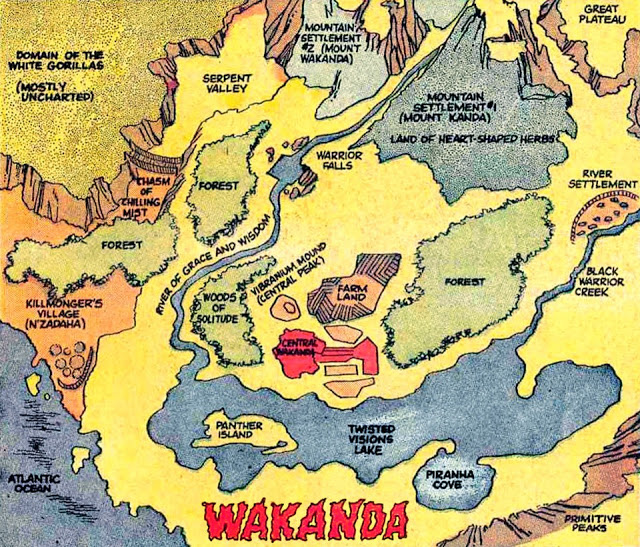
Ta-Nehisi Coates rewrote the map of Wakanda. Of all his work on Black Panther and related comics, the new map impresses me the most. It is, while not wordy, the most literary action. While seemingly nonjudgmental, the most political. He de-anglicized some of the place names and outright removed those with – at best – unfortunate connotations, such as the Primitive Peaks and what is listed on earlier maps as Domain of the White Gorillas (Mostly Uncharted). He concretized Wakanda’s six major cities, in opposition to earlier versions of “mostly uncharted” or generic “Woods” surrounding a centralized city that counts.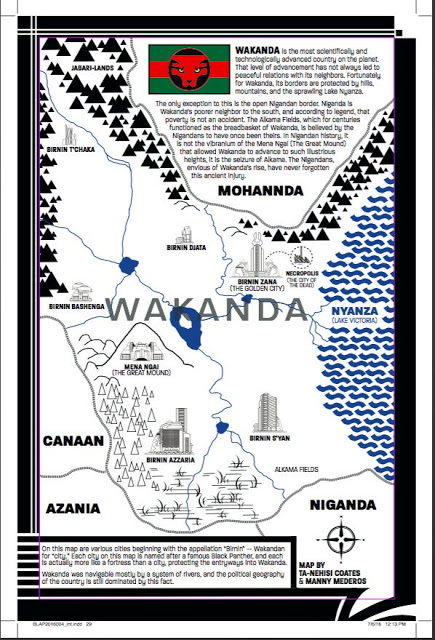 In passing, this might not even register with the average reader. Some people jump over extras, anyway, but more than that simply don’t sight-read everything and put it into an orchestrated context with a story set in the place a map is illustrating.
People do not often interpolate place names, nearness to waterways or distance from agriculture as even purposeful decisions made by an author. We do not consider it when we know the map is a fiction of a fictional place. We don’t question it when we know it’s an engineered clarification of a real space. And, to be fair, we really aren’t taught that we should, or taught how we can.
Sidenote: Coates and Stelfreeze are talking to something like seven different completely-formed and articulate audiences with every release of Black Panther.
Our primary introductions to maps probably presented them to us as objective and inarguable. It would feel different if a person went around naming everything and claiming it, in real time before us, as theirs or belonging to this ally, etc. Walk up to a local and go, “This thing you call _____ is now _____ because that’s my language and this is about me and what fits well in my mouth,” and the sense is very different than when it’s been done quietly, beforehand, without our witnessing.
The authorship of a map is usually entirely erased by the time we peruse it. That there was an author is obscured from us, in the case of real maps, so they will have the power of truth, and in the case of imaginal lands, so they have the power of conviction. To read a map without questioning the choices of labels, boundaries, or distortions is to be as colonized as the land is as the map is drawn.
We grow up reading maps and we spend year after year in school, most of us, learning cultural ecologies in History, in Cultural Geography, World Cultures, what have you, and yet, don’t consider these systems and narratives to have an angle. We expect the explanation of city life in Italy or rural life in Uganda to be as objective as the multiplication tables in Math class. We extend this to maps of fictional locales the same way we do not anticipate the math or science in a story will be false unless it highlights its falsity.
Sidenote: Anecdotal facts couched within otherwise pure fiction are still treated as objective truths by many in any given audience.
A smart author and in this case I am considering all major contributors as authors, visual artists, wordsmiths, anyone making a significant choice in regards image or text. Of course, not all comics – not all of any media – is up to the nominal authors, and sometimes you’re tasked with something, as Eliot R Brown was. A former technical artist and designer for Marvel, the first serious effort at a map of Gotham City was Brown’s first work for DC. And, it was a work where revisions seem to have piled onto revisions to the point where the work may be said to have lost any cohesive authoring, and not really, even, a steady hand stitching the piecemeal together.
In fact, the map as it has been published and republished/reused (in movies, advertisements, comics, etc) does not line up with the final version that Brown turned in.
Further down the control-scale we have the map generated for Marvel’s Age of Apocalypse, which just knocks out South America and the Middle East as “Atrocity Zone” or just irradiated wasteland, but also gives us San Francisco, Dallas, and Chicago while the “Human Settlements” in Africa (which, in comics scenes, plenty of exoticism and nonsense) are given no names or clarification.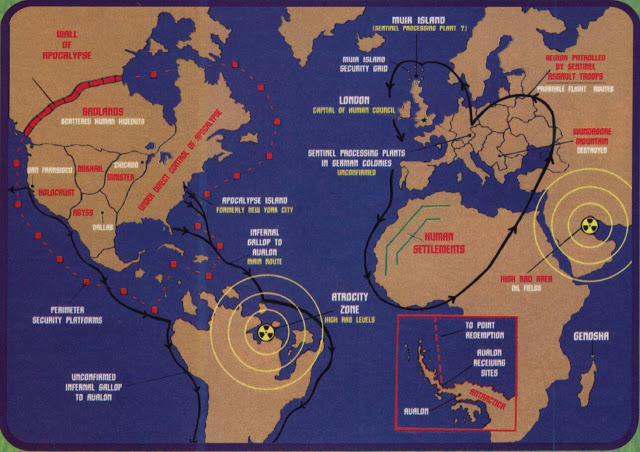 Sidenote: A cognitive map is a mental representation (and thereby a useful distortion) of the relative locations and attributes in a spatial environment. All maps of Wakanda, in print, are representative of cognitive maps.
The anglocentric nature of the map, that the only details are given over to the United States and to England, even in an anglophone comic, seems to run contrary to the intent of a map of the world, illustrating a world issue. It’s a serviceable map, but barely even that. And, even some people who worked intimately on the comics seem unsure how the map really came to be what it is. While the Gotham map may lack an authoritative author, it has authority, while this map does not even have that.
I mention these, primarily, to show the strength of the authorship and cohesive intent of the Coates and Manny Mederos map. But, divers hands or not, cognizant expressions or not, all of these maps are subject to the purviews of cultural ecology, behavioral geography, psychogeography, implicit history and the privileging of information and assumptions. Just because the Coates and Mederos map uses the phrase “political geography,” right on it, does not mean it has more of a political geography than those generated by cartographers or authors who did not use the phrase.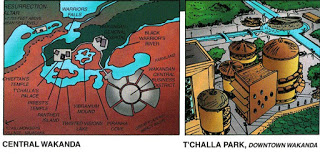 Not intending something is never the same as not doing something. Intent does not govern effect. Warrior Falls and Black Warrior Creek to the east of “Mostly Uncharted” and north of Primitive Peaks, no matter how well-intended, had certain effects back when that map of Wakanda was created, and it has different, and perhaps more sharply-felt-by-a-wider-audience effects when considered today. Knocking out all of South America as “wasteland” and leaving Australia completely off your word map has effects. The AoA map isn’t a map of the world, but a map of an embarrassingly childish American perspective of the world. The Gotham map is articulate and full, and its use by storytellers as a setting
 Sidenote: Cultural ecology is the study of human adaptations to social and physical environments. But, in fiction, the near-opposite occurs, and social and physical environments are adapted to primary characters and prefigured plots.
All maps are representative of cognitive maps. Presence and repetition, familiarity and novelty encourages our reflex perceptions and tells us our left from right, our uptown from downtown, why Australia is a continent and why Europe is one (and why some people expect Central America to be one). Maps aren’t topographies and geography. Maps, illustrate.
How we describe worlds describes us. What we accept, how we engage with maps, with the cultural and political ecologies drafted and concretized by authors can define us as readers. When I refer disparagingly to aspects of some of these maps, when I question or beg questions, I am not trying to insult, or even accuse the cartographers and authors. I am grateful for their good work, and for them having done it. Having done their work, the maps are – in many significant ways – no longer about them.
Unbreaking the Egg
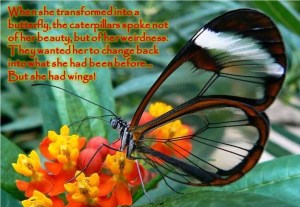 “For a seed to achieve its greatest expression, it must come completely undone. The shell cracks, its insides come out and everything changes. To someone who doesn’t understand growth, it would look like complete destruction…”
While butterflies symbolize the transformation of life, they become as iconic of springtime in the west as rabbits which, due to their energetic breeding, represent fertility. Rabbits are designated as the token animal of Germanic goddess, Eostre [Eos in Greek]. Easter, for many is a season of blurred lines between the Christian celebration of the resurrection of a crucified patriarchal savior and the celebratory pagan ritual of bunnies delivering decorative and chocolatey eggs, all representing the bounty of new life springing forth throughout nature. The Easter Bunny joins a winning cast of rabbit characters we’ve grown up fondly with: Peter Cottontail… Roger… Bre’er… Thumper [from Bambi]… the Velveteen Rabbit… Alice in Wonderland’s White Rabbit… Bugs Bunny… We might even add the Duracell and Energizer Bunnies to this roster.
I’m one who’s loved Springtime all on its own, who hasn’t needed an extra excuse to indulge in unhealthy amounts of chocolate treats which [ahem!] I do year-round. The Easter Bunny was never a seasonal distraction for me. But looking through a #MeToo lens, it’s now not a big leap to see the dark side of EOStre‘s animal-spirit. From bedtime fairytales to movies to Easter, masses have been seduced & groomed through cute but de-natured props of patriarchal predation; a mostly male character lineup that’s won over hearts and minds. And somewhere there’s probably a Playboy Bunny tie-in…

Over the top? I ask, perturbed about how Easter has become such a distraction for me this year, and a dark one at that. As I scour the Internet for my own ‘easter eggs’/clues and disclaimers, a popular Mother Goose Rhyme plays like a riddle on a loop in my mind. Then the pictures below pop up as if to illustrate to me that various renowned architects have long been on this next-level trend of appropriating and translating EOStre‘s symbols. Is this their version of putting “Humpty together again”? My question seems to suddenly render Mother Goose mute…
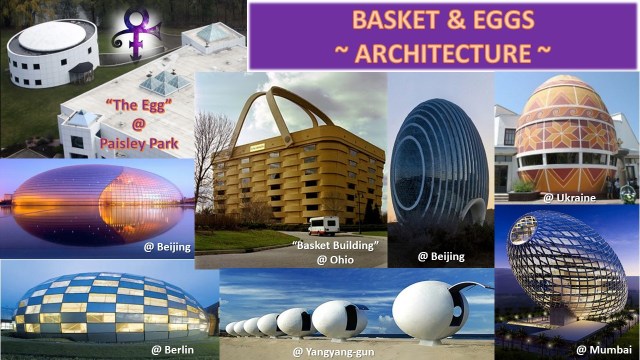
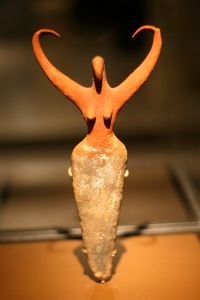 Eostre‘s Greek counterpart – Eos “goddess of the dawn” – has been compared to Khemetic goddess Tefnut, in part because of the latter’s status as goddess of the morning dew. The dawn, like the vernal equinox announces a new day… awakening… new life/birth… springtime’s resurrection/rebirth of nature from the dark sleep of winter, etc. Figurines from the Neolithic period lay an ancient and abiding claim to the divine feminine as goddess of birth, regeneration and resurrection. Iconographies of a hybrid bird-serpent-goddess appear in ancient Khemet and Mesopotamia, which represent her co-creative powers as nurturer, transformer and deliverer of the resurrected seed from her divine masculine/god.
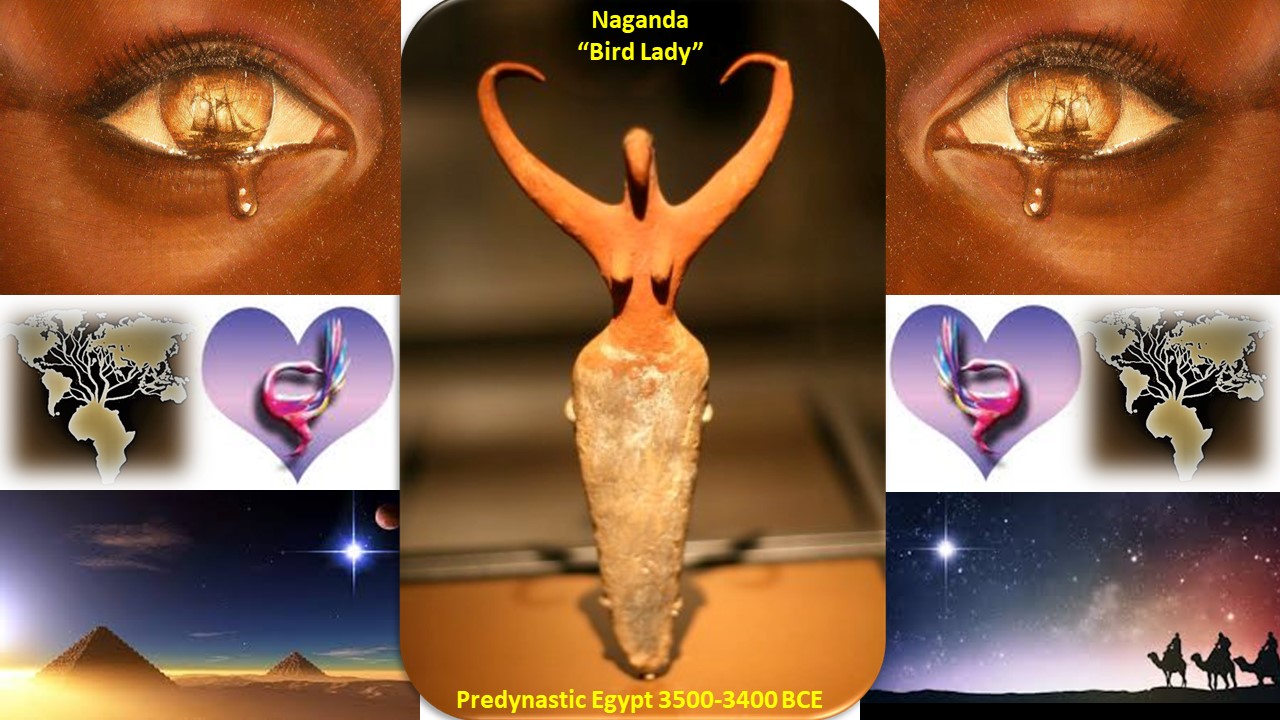
  [Left figure: Egyptian Predynastic Naganda “Bird Lady” IIa c. 3500-3400 BCE. Brooklyn Museum.] This ancient symbol has been adopted in recent times by a movement in the west whose focus on Goddess worship and femininity was precipitated by the imbalance created by homo-social male-dominated organized religions. The serpentine spiral represents kundalini energy – a life-force which both triggers the formation of the child in the female womb, and also holds the potential to uncoil from the spinal base to awaken consciousness or “3rd-eye” opening… as in Let There Be Light! [Genesis 1:3]
 Hathor [Hwt-hr, meaning ‘Mansion of Heru’ ] was worshipped in Khemet as goddess of music, dance, beauty, fertility, childbirth, women, children and foreign lands. At the Temple of Dendera which was built for worship to the Goddess during the first Intermediate period of Khemet, Hathor‘s high priests were musicians and creative artists.
 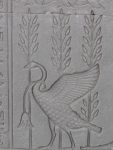 The ancient personification of feminine love, joy, mother-hood, and nature – Hathor was the original Nile Goose that Laid the Golden Egg, which was the sun god. Women particularly aspired to embody this deeply loved goddess’s conjoined roles as wife, mother and lover which gained Hathor the titles: ‘Lady of the House of Jubilation,’ & ‘The One Who Fills the Sanctuary with Joy’. Known to assist the dead in their afterworld journeys,
  Hathor also used milk from her sacred sycamore tree to restore sight to Heru‘s lunar/left eye after his legendary bruising battle against Set – usurper of Khemet’s throne.
  “His eyes are as the eyes of doves by the rivers of waters, washed with milk and fitly set.” [SoS 5:12]
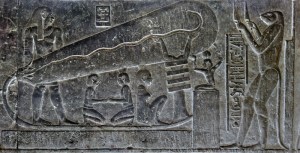 The relief on the left comes from Hathor‘s Temple of Dendera. Resembling a modern-day light bulb, the Dendera Light as it’s referred to is a depiction from the Hermopolis theology of creation. This theology presents the Ogdoad [8 primordial male-female twin deities] and the Cosmic Egg – from which all life is born. The lotus flower from the primordial sea of Nun gave birth to the sun god, Atum-Ra in a stage known as the first occasion (Dunand, 2004).
 This flower – pictured around the neck of the goose & at the base of the Dendera Light – is symbolic of Upper Khemet, from where the Nile River flows. The surrounding bulb in the Dendera light relief represents the field of the universe or Cosmic Egg/”Golden Egg” within which the process of creation… birth… enlightenment… springtime… resurrection occurs, and kundalini awakens – as depicted by the rising serpent within. Originally accessible only to high priest initiates, the accompanying texts at Dendera warn against abuse of such knowledge… seemingly in agreement with and reference to the West African mythology from Mali of the Dogon:
 After sixty years, one of the males, Ogo, broke out of the placenta and attempted to create his own universe, in opposition to that being created by Amma. But he was unable to say the words that would bring such a universe into being. He then descended, as Amma transformed into the earth the fragment of placenta that went with Ogo into the void. Ogo interfered with the creative potential of the earth by having incestuous relations with it. His counterpart, Nommo, a participant in the revolt, was then killed by Amma, the parts of his body cast in all directions, bringing a sense of order to the world. When, five days later, Amma brought the pieces of Nommo‘s body together, restoring him to life, Nommo became ruler of the universe. He created four spirits, the ancestors of the Dogon people; Amma sent Nommo and the spirits to earth in an ark, and so the earth was restored. Along the way, Nommo uttered the words of Amma, and the sacred words that create were made available to humans. In the meantime, Ogo was transformed by Amma into Yurugu, the Pale Fox, who would always be alone, always be incomplete, eternally in revolt, ever wandering the earth seeking his female soul. “
 In Genesis1:28: “God said to them, ‘Be fruitful and multiply, and fill the earth and subdue it; and have dominion over the fish of the sea and over the birds of the air and over every living thing that moves upon the earth‘” (NRSV). As a well-intentioned environmental steward mansplains from biblcal text: “First the word “subdue”. In Hebrew this is kabash. You can’t get around it; it does mean… “enslave”, and even in the harshest instances “molest” or “rape”… Ummh, Yurugu/Set better stay in his lane!!! In my own well-intentioned effort to not throw the baby out with the bathwater, I’ll follow the lead of the Shulamite sistah who knows “love is strong as death” [Song of Songs 8:6]. She is the Southern Queen to whom the God of Revelation [3:11] says: “Behold, I come quickly: hold that fast which thou hast, that no man take thy crown.” May our circle 4ever B unbroken... ❤ ❤ ❤ #13031
Refs:
Dunand, Françoise, and Christiane Zivie-Coche. 2004. Gods and Men in Egypt: 3000 BCE to 395 CE. Ithaca: Cornell University Press.
Tut’Ankh’Amun ~ Reflections
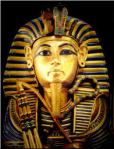 The “KING TUT: Treasures of the Golden Pharaoh” tour ends its world premiere today [January 13th, 2019] before moving on to Europe and eventually back to Africa where the exhibition will remain permanently at the Grand Egyptian Museum in Cairo. Since March 24th, 2018, the California Science Center has been hosting the only scheduled US exhibition of over 150 personal belongings from 18th Dynasty King Tut’Ankh’Amun’s 3,300 year-old burial site that were among those removed after the 1922 European discovery and raid of his tomb in Africa’s Valley of the Kings, west of the Nile River. Each of King Tut’Ankh’Amun’s burial artifacts are presented in the exhibition as narrative pieces of the pharaoh’s quest for immortality as he journeyed through the underworld after his death at the young age of 19 to find his place in the afterlife.
Of the several culturally-significant pieces in the exhibition, two are particularly striking:
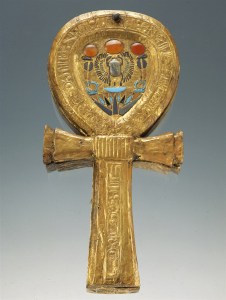 1. King Tut’Ankh’Amun’s gilded ankh-shaped mirror case ~ One of the best-known ancient symbols that is often depicted in the firm grip of a Khemetic deity’s hand is the ankh. With its feminine oval and masculine crucifix, the ankh represents what the ancients regarded as the key of life. When used in hieroglyphic writing, the ankh may mean “mirror,” “floral bouquet,” and/or “life.”
  Several ankh-shaped mirrors were created in ancient times and, like the one now missing from King Tut’s belongings, were thought by many to reflect eternity. Mirrors/looking glasses were believed to possess magical properties which would respond to the user’s intent, ranging from superficial vanity… to revelations of the light/shadow afterlife from the reflected physical prism… to connection with one’s eternal seer, divine reflector, & true beloved or “twin-soul”…
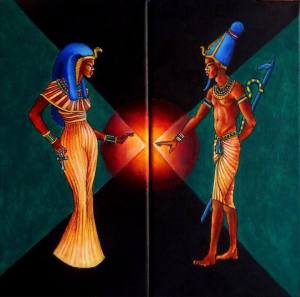
Click to hear “Be My Mirror” by Prince [unreleased track]
 Similarly, Goddess Seshat – dressed in her signature panther-skin dress – is known in her own right as the “opener of Heaven’s door.” Thus the key of life [‘ankh’] in essence infers the creative interplay between multidimensional and complementary creative forces – within/without… above/below – which in turn confer special standing upon rulers in the earthly realm such as King Tut’Ankh’Amun.
Tut’Ankh’Amun was originally named Tut’Ankh’Aten [“living image of Aten”] after his father Akhenaten, the controversial King who upended Khemet’s centuries-old religious system in Uaset [Gr. ‘Thebes’], to the worship of the singular sun disc Aten from a new religious center in Amarna. Following Akhenaten’s death and a brief intervening period of rule by two pharaohs, aided by powerful advisers, the 9-year-old prince ascended the throne his father had held. During his own 10-year reign, the young pharaoh reversed his father King Akhenaten’s legacy by restoring Khemet’s long-standing god Amun to supremacy and its religious capital to Uaset. He then reaffirmed this allegiance by formally renaming himself Tut’Ankh’Amun – the name we’re most accustomed to, meaning “living image of Amun.” Thus, the king chose the image ‘above’ and ‘within’ that he wanted to mirror and/or to become as…
 2. The King’s mode of underworld/afterlife transportation ~ The black panther depicted in this artifact from Tut’Ankh’Amun’s tomb acts as a fascinating spiritual and cultural “mirror” between past and present. The biggest movie of 2018, Black Panther, was released in the month just prior to the “KING TUT: Treasures of the Golden Pharaoh” exhibition opening at the California Science Center. As I wrote in a previous post, the scene in the movie in which a presumed-dead King T’Challa journeys through the plane of his Wakanda ancestors… mirrors this specific rendering of King Tut’Akh’Amun whose other, signature golden image is itself a “death mask” – perhaps implying that his physical death was an illusion.
The fictional name ‘Wakanda’ in turn reflects the names of real-life kingdoms such as Buganda through which the source of the great Nile River flows, and from where powerful panther kings – entitled Kabaka – still hold sway. As the earthly mirror of the Milky Way in heaven [called Maziwa Mkuu in Kiswahili, meaning ‘great milk’] this sacred River is the true, nature-based Ma’atrix that gave rise to the spiritual-consciousness of ancient Nile Valley civilizations such as Khemet and Buganda. 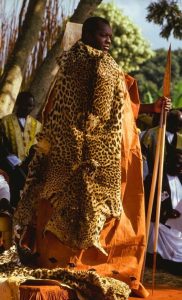 Black panthers are a melanistic variant of the African leopard whose skin features significantly in the regalia of Kabakas and royalty of surrounding kingdoms in present-day Uganda, as well as in the dress of Khemetic deity Seshat – the above-mentioned “opener of Heaven’s door.” Conferring high status on the wearer, this skin [which may also lie beneath a royal leader’s feet] represents the musambwa or territorial spirit in the Uganda region who appears in the form of a panther/leopard and acts as a supernatural guide and protector of the kingdom…
The Baganda have a saying about their royals: “A Kabaka does not die, but gets lost in the forest.” It alludes to their immortality and the possibility of return for those chosen ones who are able to find their way through the forest. 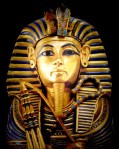
 Depending on how one examines the mirror/ankh, this ‘forest’ could metaphorically reflect the prophesied 400-year wilderness period [Genesis 15: 13-14] since enslaved Africans first set foot in America. The timing of Black Panther‘s release, T’Challa’s mirrored visual of King Tut’Ankh’Amun’s crossed crook and flail which are symbols of the biblically-mirrored Great Shepherd – reflects this larger, multi-layered Savior narrative…
 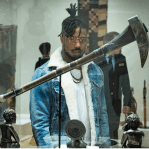 A true visionary, Ryan Coogler re-links the cultural elements while critiquing the European world’s appropriations, e.g. through Eric Killmonger’s retort to the British Museum director: “How do you think your ancestors got these? Do you think they paid a fair price? Or did they take it… like they took everything else?”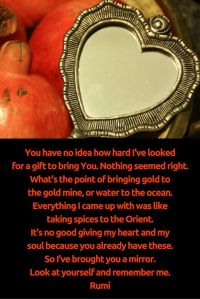
Now, as the “KING TUT: Treasures of the Golden Pharaoh” exhibition moves on from America for the last time, I can’t help wondering what happened to the King’s priceless mirror/looking glass…?
 May this ‘Year of Return’ reawaken humanity to its best reflection and most magnificent Heaven-on-Earth manifestations…
***
NEWS: Egypt seeks Interpol help to retrieve Tutankhamun bust sold in UK
RELATED: Westminster Abbey stops Ethiopian priests visiting holy tablet. Abbey accused of cultural insensitivity over artefact looted in 1868
Ascension ~ “Black Orchid”
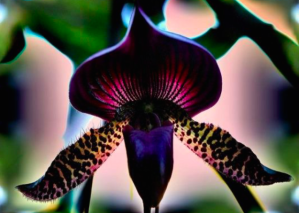 “…She has touched the farthest star
Her beauty speaks of what we are
And her freedom makes us free
Her now is in eternity, infinite to all that see
And her dreams have been achieved
Now there is a sound of laughter
Nature sings out her name
For the world to know her fame… ~ Black Orchid ~” [Stevie Wonder – from ‘Journey Through the Secret Life of Plants’]
During the months of July and August, 2018 Mother Earth is responding to an amazing shift in the Harmonics of the Spheres. The Sun’s gravitational pull has aligned to one side of itself all of the planets in the solar system, each with their own unique frequencies. Read More

 Malaika Mutere