
“End of The Road” ~ Tyka
Just.Beautiful. 💜 💜 💜 On a day when, as a daughter and sister, I give thanks for the precious and undying family bonds which continue to guide and sustain me from the infinite Beyond of our Spiritual Being and Becoming… Thank you so much for sharing the message of “End of The Road” in your 6/7/17 commemoration and upload of this exquisite song, which continues to gift our ears and hearts with your warm, familiar, and welcome Nelson Freequency, Tyka. 💜🕊️☮️ [🙏🏾REST IN PEACE, SIS 💜🕊️☮️ TYKA EVENE NELSON: May 18, 1960 ~ Nov 4, 2024 🙏🏾]

“A Luta Continua”…
 ‘A LUTA CONTINUA’ (in English: the struggle continues) was the rallying cry of Africans fighting against Portuguese colonial rule in Mozambique. It originated during the armed struggle led by Dr. Eduardo Chivambo Mondlane, first president of the FRELIMO Liberation Front in the war for independence, who said, “We fight together, and together we rebuild and we recreate our country, producing a new reality – a New Mozambique, United and Freed. The struggle continues!” Following Mondlane’s assassination in 1969, Africans continued to rally around this slogan under the successive leadership of
  Samora Machel who went on to become the first president of an independent Mozambique in 1975. A luta continua is the unofficial national motto of Mozambique where the colonial language of Portuguese remains official.
A Luta Continua is the title of a song popularized by South African singer and activist, Zenzile Miriam Makeba – who is fondly referred to as Mama Africa. The song was written for Makeba by her daughter Bongi – from “Sibongile” (meaning “we are grateful”) – after she attended Mozambique’s 1975 independence ceremony.
By the late 1950s Makeba had achieved musical fame in South Africa, and her appearance in the 1959 documentary film Come Back, Africa attracted the interest of Harry Belafonte and others in America. Her singing and recording career reached new levels of success in the United States, where she introduced Xhosa and Zulu songs to Western audiences. Makeba’s activism included support of Kenya’s independence from British colonial rule, whereafter she and Belafonte became VIP performers at the Independence Day celebrations at the invitation of President Jomo Kenyatta.
Makeba was the only performer at the meeting in Addis Ababa that led to the formation of the Organization for African Unity. She also testified before the United Nations Special Committee against Apartheid, asking for economic sanctions and an arms embargo against South Africa’s National Party government. This activity, along with the increasingly political content of her music caused the apartheid government in South Africa to revoke Makeba’s passport and ban her music, whereafter she lived in exile for 3 decades. In 1964 she married trumpeter Hugh Masekela, a fellow South African in exile and protégé of Harry Belafonte. Masekela wrote the protest song Makeba performed entitled Soweto Blues about the 1976 uprising in Soweto.
The 1960s saw Makeba’s involvement with Civil Rights, anti-apartheid, Black Consciousness, and Black Power movements grow. She married Black nationalist Stokely Carmichael [Kwame Toure] in 1968 (divorced 1979) who relocated with her to Guinea in West Africa. Encouraged by Nelson Mandela who had just been released from his 27-year imprisonment by South Africa’s apartheid regime, Mama Africa returned and performed in her home country for the first time since her exile in 1991.
Known fondly as “Aunty Dorothy,” Dorothy Masuka is often credited with composing one of Miriam Makeba’s most well-renowned songs entitled Pata Pata. The two songstresses were contemporaries, Masuka being born in neighboring Zimbabwe [then Rhodesia] in 1935, about three years later than Makeba, before emigrating to South Africa at the age of 12. Masuka spoke of the spiritual sources of her musical inspiration that often came in dreams from an early age, one of whom was her maternal grandmother, a sangoma [a respected traditional healer]. From the start of her career, Masuka endeared herself to a wide audience but the political content of her compositions such as Lumumba (of Congo) and Dr. Malan (an anti-apartheid song) led to her exile following the apartheid government’s ban over her recordings. Masuka continued to campaign through song for African liberation during her exile in Malawi and Tanzania, inspiring many including Makeba. Her work entitled Mzilikazi paid tribute to one of Emperor Shaka Zulu‘s greatest warriors who founded the Ndebele people of Zimbabwe and South Africa.
❤ Mamas, Aunties & Sista-Queens who hold up half the sky… Thank You… Sibongile ❤
❤ ❤ ❤





Earth, Wind, Fire & Water
 Earth Wind & Fire (EWF) is undoubtedly one of the greatest bands of all time, as their claim to three of the four natural elements suggest they should be! Hits like In the Stone provide EWF fans an Afrofuturistic portal through which to access and interpret some of the Mysteries of ancient Egypt, the “gift of the Nile.” Djehuti – god of communication/writing, magic and wisdom – recognized Africa as god’s chosen land where the northward flow of the Nile gave rise to sacred Mysteries, mythologies and the architectures that arose along its river-banks. He referred to this psycho-geographic mirror of heaven-on-earth (known locally as Maziwa Mkuu – “the Great Milk” or Milky Way) as the Temple of the World.
  At Uaset on the river’s east bank, Ipet Resyt – the “southern sanctuary” of god/dess consorts Amun-Mut – was constructed to resemble the human form. It was at such temples where ancient Mysteries were housed as sacred knowledge for chosen initiates. Inscribed within the stone walls of this temple’s ‘throat area’ is the pre-Christian Annunciation [1350BCE] from Amun to his beloved about the divine child and savior-figure she would bear.
Well-versed in such ancient Theogony, some of which he himself is said to have authored, Djehuti understood EWF as base elements that separately defined each of humanity’s precursors to the breaking Age of the Bearer of Water – the 4th element which is swayed by the moon and, like Earth, is organically associated with the Divine Feminine [Mut]. The dawning Age of Aquarius is defined by this being the constellation the sun is moving into on the spring equinox in its 26,000-year journey through all 12 zodiac houses. Each successive grand age (approximately 2 millennia per sign) is heavily influenced by the sign’s element:
 EARTH is the element which defined the Age of Taurus between c4400-2200 BCE, a time period traversing the Bronze Age which followed the previous Age of Gemini and supported the evolution of material culture around the world. Characterized by some as humanity’s Age of Growth, this was the grand age when the Sun was in the fixed sign of Taurus [Ausar – The Bull of Eternity]
 . Ancient Egypt’s Early Dynastic Period [c3150-2613 BCE] began with the Unification of Upper (south) & Lower (north) Egypt under Pharaoh Menes aka Narmer in 3100BCE.
  Called Sema Tawy, this unification was symbolized as a human trachea arising from the lungs (heart-chakra) entwined with the papyrus (north) & lotus (south). Narmer‘s was the first of 30 successive dynasties which ruled and maintained civil order through a centralized government from the capital of Men-Nefer/Memphis.
  Ptah – god of craftsmen and sculptors who was venerated during this period – was heralded by Apis, the sacred bull-deity of ancient Egypt who was also the symbol of the Pharaohs of these times.
  By 2400BCE the basic formulation of the myth regarding Ausar-Auset, and their posthumously-conceived son Heru’s further contendings against Set (murderous throne-usurping god of foreigners, plague and chaos) was in place – a universal archetypal narrative which has survived from the Pyramid Texts to this day in derivative religious forms and “good-versus-evil” scripts and schemes that have been executed for better or worse around the world. Technological advances during this Age of Growth included the invention of hieroglyphs/Holy Writing [Djehuti] & manufacturing of papyrus/Paper which helped facilitate record-keeping, communication, etc.
  Furthermore, the Old Kingdom Period [c2613-2181BCE] saw two of the greatest architectural Wonders and Mysteries ever erected –
 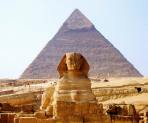 the Giza Pyramids and the Great Sphinx which connect earth organically to heavenly powers. Seen another way, EARTH is the English language anagram for HEART… an ages-old Mystery mapped out from humanity’s womb & written in African stone… which “Set” has characteristically intended by any/all means to violate.

 FIRE is the element which defined the years that led from c2200 BCE [following the transition between Egypt’s Old & Middle Kingdoms] to the beginning of the Common Era. This was the period when the Sun relocated from Taurus in its ongoing precession to arise in Aries [Amun The Ram] – leader of the western Zodiac, & the cardinal sign which begins the Spring season in the northern hemisphere. Uaset [Thebes/Luxor] had superseded Men-Nefer [Memphis] as the ancient Egyptian capital by 2240BCE. Amun, now the venerated deity, was worshipped in 2 main temples where the Gemini bonds formalized during the Age of Taurus continued to be upheld & ritualized at Amun-Mut‘s Ipet Isut [northern sanctuary – Karnak] & Ipet Resyt [southern sanctuary – Luxor].
 Ipet-Resyt is where eternal truths (including those held in the ‘throat area’) – such as ‘The Kingdom of Heaven is within you’ & ‘Know Thy Self’ – are written in stone. The Age of Aries is thus characterized by some as the Age of Law because this is when humanity’s first codes of justice and moral instruction were recorded. Of particular note were the Negative Confessions upon which Judeo-Christianity’s Ten Commandments were later formulated from the Papyrus of Ani source, recorded c1275-1250BCE during the prosperous New Kingdom era. Also known as the Declarations of Innocence, this recitation in the Halls of Judgment of 42 uncommitted sins facilitated the transition of the soul between their earthly incarnation and the afterlife.
  The soul was weighed in the scales against the feather of Ma’at, goddess of Truth, Balance, Divine Order, Harmony, Reciprocity, Reparations & Justice [Libra]. The Age of Aries additionally saw the rise of Akhenaten, whose reputation became that of ‘the heretic king’ after his unwelcome cultural reforms, including the self-centered monotheistic cult of Aten-worship he instituted & oversaw from Amarna [1353-1336BCE].
  Aten’s successor, his son who renamed himself from Tut’Ankh’Aten (‘living image of Aten’) to Tut’Ankh’Amun (‘living image of Amun’) eventually restored ancient Egypt’s cultural traditions around Amun & returned its worship center to Uaset before his death at age 19 in 1324BCE.
 WATER is the element which has defined the Common Era (Gregorian calendar) years to date during which the Sun transitioned to arise in Aries’ mutable neighbor Pisces, and usher in what some define as the Age of Faith. The 1450’s Gutenberg press & evolution of transportation fueled the global reach & self indulgent agendas mainly of Christianity amongst the Abrahamic faiths. Though their holy books were in agreement with each other – often representing derivative text from Kemetic sources – several wars broke out, due in part to competitive cult elements that developed around their egoic patriarchal ideologies.
  Africa’s experience during the Piscean Age of Faith – which began with the Greco-Roman construction of a Gregorian timeline around the life of Judeo-Christianity’s savior-figure, Jesus – has been a major revelation of the enduring myth written in ancient Egypt during the Age of Taurus. Ausar-Auset-Heru were the original holy trinity whose very being was tested by Set – god of foreign usurpers, plague and chaos.
 Jealous of their Heaven-on-Earth glory in ancient Egypt, Set murdered & mutilated King Ausar, scattering his 14 separated body parts into a wilderness where Queen Auset was forced to conduct her search-&-recovery mission as Set illegitimately assumed the throne. The “wilderness” is allegorical to Africa’s experience of chattel slavery [1619-];
  the colonial rape and reconstruction of Africa [1884-]; apartheid [1948-] etc… all at the hands of foreign invaders [“Set”] who justified such acts and their accompanying atrocities in the name of the god(s) of their heavily-published “faith(s).” In the ancient mythology, Auset mummified the 13 pieces she was able to recover of her husband, while relying on divine intervention to posthumously conceive their son Heru, despite Ausar’s missing 14th piece, symbolized as the tkhn. Christianity translated this episode into its account of the “Immaculate Conception,”
 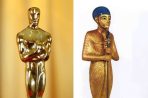 replacing Heru with Jesus (+crucifixion plot twist) as avenging son & savior who restores Heaven-on-Earth’s rightful rule. “ΑΩ White Man’s Burden… Manifest Destiny… Western Exceptionalism… Zionism… Trumpism” = samples of the Age of Faith’s cult-like justifications & controlling narratives that continue to be extolled, executed, & policed.
 AIR is the element which will define the next 2,000+ years as humanity decides what the narrative and legacy of this new Age of Aquarius should be(come) during the sun’s rising and sojourn prior to travelling from the Aquarius constellation to the next – presumably Capricorn.
  What’s fascinating to me is that the sun’s own path of enlightenment is a reverse journey through the western zodiac which is sequenced as Aries ruling the 1st house… Taurus the 2nd, Gemini the 3rd etc. through to the 12th and final house of Pisces. As Sankofa from the ancient African wisdom of the Akan suggests, perhaps there was something forgotten, lost, &/or stolen from a previous era which is absolutely necessary for humanity’s holistic Ascension? 2019 – Africa’s “Year of Return” – marked the end of 400 prophetic “wilderness” years [via Set] in the northern hemisphere. One might view this as an initiation period in which the south-north bonds [UbuNtu/Sema Tawy] that were avowed in ancient Egypt during the aforementioned Ages of Ausar [Taurus] & Amun [Aries] following Egypt’s pre-Dynastic Age of Gemini are once again affirmed. Some have referred to 2019 as the “Year of the Divine Feminine” and 2020 as the “Year of the Divine Masculine,” while envisioning 2021 as the reunification “Year of Divine Twins” [Gemini].
  Aquarius, the fixed air sign in western astrology, is symbolized as the water-bearer of the zodiac. Divine Twins who’ve spent lifetimes journeying towards reunification through self-reflection now offer their enriched drinking gourds to each other & say to the intuitive-emotional water element within, “Be still, and know that I ❤ AM GOD” [Psalm 46]. Air, the element Gemini, Libra, & Aquarius represent, is the oral-aesthetic energy which reveals itself in Kemet’s south-north/lotus-papyrus unification symbol as well as the Annunciation in the ‘throat area’ of Ipet Resyt [southern sanctuary – Luxor]. Perhaps this Age of UbuNtu/New Earth is a Revelation ~ the ancient Promise of True.Love.Written.In.The.Stone [EWF] Blessed Be ❤ ❤ ❤
“Shut This Down” ~ [P ft MJ]
 Did you ever want to see that collab between Prince & MJ?! YouTuber Raphael Tavares delivers this mix of Pince’s “Shut This Down” [2015] as a soundtrack to MJ’s provocative moves in “Black or White” [1991]. Besides this mix being reminiscent of the “Bad” [’87] collab that didn’t happen between the two for reasons Prince gives in his 1997 Chris Rock interview with a wink-&-nod, Tavares’ posthumous rendering conveys a prophetic reading of the black panther‘s Africa-centered totemic symbolism & role …a whole nutha-level cultural narrative that’s resonant with current events, alongside Sopdet‘s journey in her zodiac today. [+++ Check out P covering MJ/J5 below… Yaasss 2 the Sista-power!!! ❤]
Posted in honor of African-American Music Appreciation Month – observed in the United States during the month of June since 1979 under the presidency of Jimmy Carter. The first and last years of Barack Obama’s presidency saw the transitioning of the two African-American musical giants: Michael Joseph Jackson [6/25/09] & Prince Rogers Nelson [4/21/16]. RIP… Don’t get lost in the forest…
❤ ❤ ❤
Presidential Proclamation — African-American Music Appreciation Month, 2016
AFRICAN-AMERICAN MUSIC APPRECIATION MONTH, 2016
BY THE PRESIDENT OF THE UNITED STATES OF AMERICA
A PROCLAMATION
A vital part of our Nation’s proud heritage, African-American music exemplifies the creative spirit at the heart of American identity and is among the most innovative and powerful art the world has ever known. It accompanies us in our daily lives, and it has rung out at turning points in our history and demonstrated how our achievements as a culture go hand-in-hand with our progress as a Nation. During African-American Music Appreciation Month, we honor the artists who, through this music, bring us together, show us a true reflection of ourselves, and inspire us to reach for the harmony that lies beyond our toughest struggles.
Songs by African-American musicians span the breadth of the human experience and resonate in every corner of our Nation — animating our bodies, stimulating our imaginations, and nourishing our souls. In the ways they transform real stories about real people into art, these artists speak to universal human emotion and the restlessness that stirs within us all. African-American music helps us imagine a better world, and it offers hope that we will get there together.
This month, we celebrate the music that reminds us that our growth as a Nation and as people is reflected in our capacity to create great works of art. Let us recognize the performers behind this incredible music, which has compelled us to stand up — to dance, to express our faith through song, to march against injustice, and to defend our country’s enduring promise of freedom and opportunity for all.
NOW, THEREFORE, I, BARACK OBAMA, President of the United States of America, by virtue of the authority vested in me by the Constitution and the laws of the United States, do hereby proclaim June 2016 as African-American Music Appreciation Month. I call upon public officials, educators, and all the people of the United States to observe this month with appropriate activities and programs that raise awareness and foster appreciation of music that is composed, arranged, or performed by African Americans.
IN WITNESS WHEREOF, I have hereunto set my hand this thirty-first day of May, in the year of our Lord two thousand sixteen, and of the Independence of the United States of America the two hundred and fortieth.
BARACK OBAMA
“She Gave Her Angels” ~ Prince
A song of adulation, love and fear
No one loved him better, no one better sacrificed
She gave her angels that summer night
Destiny and love don’t always go hand in hand (Hand in hand)
As the world lay waiting like an embryo in a womb
She gave her angels that night in June (She gave her angels)
To watch over him till she returned – her man, her lover, her son
Her father for all these things he meant to her, she felt it right
She gave her angels that summer night [Repeat: 2X]
- Songwriter/Artist: Prince Rogers Nelson (as
 )
) - First Released: 29 January 1998 – Crystal Ball album
- Fan Music Video by VDJ Vivacity …“This is a beautiful Prince song and definitely deserved a full music video beyond the snippet performed on Muppets Tonight.“ (LINK added by me 🙂 …SEE ‘She Gave Her Angels’ Muppets footage @ 17:42)

When Doves Sing… Musings
 April 21st marks the anniversary of a day, four years ago, when Majesty and Divinity fell uncharacteristically silent. I learned about this after hearing their voices on a hauntingly beautiful music track that I’ve only recently discovered. I’d been drawn by the title of the track as I waxed nostalgic about the teenage version of me who’d walk several miles between my family home in Spring Valley to Kenya High during holidays just to play one of my school’s pianos for an hour or so. Granted that was less time than it had taken me to get there on foot, but I had the return trip to consider. Along the way, I’d pass by the Chiromo campus of the University of Nairobi where I’d always feel rejuvenated by the lush greens and natural habitation of the adjacent arboretum…
Arboretum, the moving piano piece in question that Prince recorded in his atrium at Paisley Park, is the 10th and final track on his 25th studio album entitled One Nite Alone… Released by NPG Records on May 14th 2002, Prince thoughtfully noted, “Ambient singing: the doves – Divinity and Majesty” in his Album Credits. Prince’s beloved pets are heard and warmly felt, presumably from their cage on the balcony overlooking Paisley Park’s sky-lit atrium as the artist performed & recorded his composition. At the end of Arboretum, the sound of heeled footsteps on an uncarpeted floor come through, painting an image on my mental screen of the artist walking away from his piano, perhaps retreating to a more personal recess of his creative complex that has now become a museum in suburban Minneapolis…
Chanhassen (said Minneapolis suburb) is a First Nation name in the Sioux language of the Dakota, meaning the tree with sweet sap – or sugar maple tree. Arboretum (trans: ‘botanical garden devoted to trees’), may well have been Prince’s musical alignment with & nod to the Minnesota city of his residence. Inspired by this thought, my memories meander between Nairobi Arboretum & western Kenya’s Kakamega Forest where I wasn’t an unfamiliar presence. I remember rhythmic singing suddenly breaking out from the perches of Red-eyed Doves (Columba semitorquata), which made me want to celebrate in dance each time. [Ref. Dove #2 in Lynette Rudman’s video below: #1: Tambourine Dove; #2: Red-eyed Dove; #3: Ring-necked Dove; #4: Mourning collared Dove; #5: Laughing Dove; #6: Emerald-spotted Wood Dove; #7: Namaqua Dove].
I’d like to imagine that my late father, a zoologist who specialized in the study of bats, would indulge my efforts to do due diligence to scientific inquiry [*ahem!]… albeit in service to these belated musings on the environs of Paisley Park and its mysterious, dove-loving nester. Speaking of which, in his first hit from Purple Rain – the 6th studio album that was released on June 25th, 1984 – Prince may creatively have been going for the ambience of Zenaida macroura [*cough!] – aka Mourning Doves. Now every time I hear the haunting and sad cooing sound for which this ubiquitous species is named, I think When Doves Cry…
Majesty and Divinity simply “stopped talking” after Prince crossed over, according to his sister Tyka in a 2016 Today show interview. Upon realizing this, Tyka instructed the Paisley Park staff to “play some Prince music” for his pet doves in order to help bring them out of their mournful silence. Just wow! Mother Nature’s collective consciousness is a font of endless fascination, particularly for me as a somewhat quirky expression from humanity’s African source. From his space in the diaspora, Prince was tapped into this same source on levels I’m only now beginning to appreciate. Beyond his music, there’s coded mystery in the architectural choices of the artist’s Paisley Park nesting and creative space that awaken my own epic memory. There are the pyramid skylights on the main building… the separate yet connected ‘Egg building’… and even the address itself…
…7801 Audubon Road is Paisley Park‘s street address which for me recalls renowned ornithologist John James Audubon. Born in Haiti in 1785, Audubon was noted for his paintings of birds, over 1,000 of which were documented in his book, Birds of America. The National Audubon Society was founded in his memory in 1886 to focus on the preservation and study of birds.
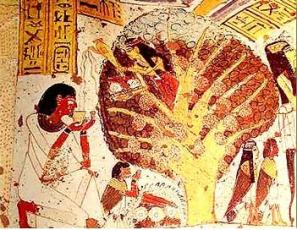 But beyond their zoological details, birds are profoundly symbolic as winged messengers who navigate the skies and/or heavenly realms. Doves in particular symbolize love, hope, peace, gentleness, inner initiation, the Holy Spirit, eternal life… In the biblical Song of Songs there are several dove references in the communication between the Shulamite and her Beloved’s conjoined Spirit. One of the references that I visit time and again is: “His eyes are as the eyes of doves by the rivers of waters, washed with milk and fitly set” [SoS 5:12]. In the pre-biblical Auset-Ausar-Heru mythology of Kemet,
  Goddess Hathor – “Lady of the Southern Sycamore” – used milk from Her sacred tree to restore sight to Heru after one of his epic battles against Set (usurper of Ausar’s heaven-on-earth throne). Heru – a precursor savior-figure and defender of his father Ausar’s throne (depicted as Auset’s crown) – is himself portrayed as a falcon-headed god. *******
“ARBORETUM”… The messages that a gently-played piano and a well-placed mic cause my quirky African ears to hear in 5D+… The ambient coo-ing of Majesty and Divinity, who raise homing frequencies into realms that cloak ascended masters from far too many robotic eyes & ears… “Don’t get lost in the forest,” Mother Tree entreats, long after his retreating footsteps have become silent… He ventures forth with the sweet sap of other trees which cause 3rd-eyes to open & soulful consciousness to reign like Purple… “Yo Twenny/Twenny, W’sup!? DJs R droppin’ beats like mad Grand Mixers @ homie’s joint. We jumpin’ time-lines… 2012 Party Override!”
If I could be the Red-eyed Dove’s lyricist during these roller-coaster times, my words to its rhythmic song would be: “I. Am! B’Cuz? …We. Rrrr!” Nothing fancy. Just a cultural mantra that takes me back to Mother Nature’s embrace & the free-quency of the great “I AM.” Throw some dance-floor swag up in that Song of Songs, like back in the day 😉 Old-School-style...UbuNtu, the guiding narrative of our 5D+ uni-verse: “I Am because We are!” In order to move forward on our S/Hero Journey, Sankofa adds that: we must first recover & reclaim that which was forgotten ,
, lost or stolen. ❤ ❤ ❤ So Keep Your Vibrations High, Dearly Beloved ❤ Don’t let ‘the elevator bring us down’ ❤ Know that U R Majestic and Divine ❤ Let no one take Thy Crown [Rev. 3:11] ❤ ❤ ❤
“Woyaya” ~ Osibisa & Elephant Art
 Woyaya – the catchy title song of the second album by Osibisa, a London-based Ghanaian and Caribbean Afro-pop band led by Teddy Osei – was released in 1971 and would frequently be heard in various settings throughout 1970-80’s Africa. By the time it was reissued in 2004 along with the self-titled first album [Osibisa], the song had been covered by musicians such as The 5th Dimension & Art Garfunkel [1973]. Wiyaala [click pics for music] provides a 2020 version of the classic in which, for Osibisa fans the uplifting expression “woyaya” has since come to literally mean “we are going…” Read More
Congo Square ~ UbuNtu & the Unbroken Circle
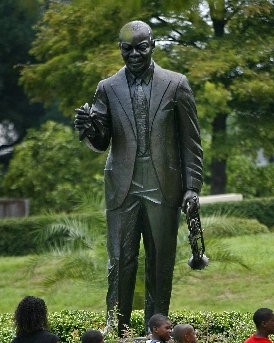 “The bloodlines of all important modern American music can be traced to Congo Square,” musician and trumpeter, Wynton Marsalis once said of this national treasure – the historic birthplace of jazz and Rhythm-‘n’-Blues. Situated in what is now the Louis Armstrong Park in Tremé, the oldest African-American neighborhood in the tricentennial city of New Orleans – at 2.35 acres, today Congo Square measures approximately half of what it was in its heralded 19th century years.
New Orleans, Louisiana [NOLA] is a major US port whose strategic location facilitates the trafficking of commercial goods between the Gulf of Mexico and the Mississippi River system, which historically included trans-Atlantic cargoes of enslaved Africans. Congo Square was a gathering place Read More

 “Towards a Transformation Communication Theory: UbuNtu, Prince, and the Oral-Aesthetic Perspective” was recently published in The Journalist SA. To read the article, click here: http://www.thejournalist.org.za/academic-papers/towards-a-transformation-communication-theory-ubuntu-prince-and-the-oral-aesthetic-perspective

UbuNtu ~ On Owning Your Masters
 “If you don’t own your masters, your masters own you.” On his B’Earth’Day [June 7th] in 1993, Prince changed his name to the unpronounceable ‘Love Symbol’ of his recently released 14th studio album following disagreements with Warner Brothers [WB], the label which originally signed him in 1977. It was a public act of rebellion against WB’s restrictions over him and his prolific creativity. Likening their contractual relationship to one of indentured servitude or slavery, Prince explained:
Read More
Water Bearers & New Age Libations
 “When the moon is in the 7th House… And Jupiter aligns with Mars… Then peace will guide the planets… And love will steer the stars… This is the dawning of the Age of Aquarius…” [Lyrics from “Age of Aquarius” by the 5th Dimension, 1969].
Humanity is said to be currently moving to its new astrological Age – an event which happens roughly every 2,000-plus years. We’re living through a transitional period Read More

 Malaika Mutere