
Tut’Ankh’Amun ~ Reflections
 The “KING TUT: Treasures of the Golden Pharaoh” tour ends its world premiere today [January 13th, 2019] before moving on to Europe and eventually back to Africa where the exhibition will remain permanently at the Grand Egyptian Museum in Cairo. Since March 24th, 2018, the California Science Center has been hosting the only scheduled US exhibition of over 150 personal belongings from 18th Dynasty King Tut’Ankh’Amun’s 3,300 year-old burial site that were among those removed after the 1922 European discovery and raid of his tomb in Africa’s Valley of the Kings, west of the Nile River. Each of King Tut’Ankh’Amun’s burial artifacts are presented in the exhibition as narrative pieces of the pharaoh’s quest for immortality as he journeyed through the underworld after his death at the young age of 19 to find his place in the afterlife.
Of the several culturally-significant pieces in the exhibition, two are particularly striking:
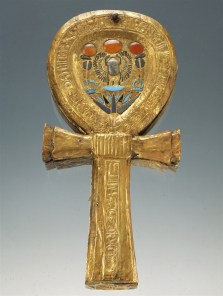 1. King Tut’Ankh’Amun’s gilded ankh-shaped mirror case ~ One of the best-known ancient symbols that is often depicted in the firm grip of a Khemetic deity’s hand is the ankh. With its feminine oval and masculine crucifix, the ankh represents what the ancients regarded as the key of life. When used in hieroglyphic writing, the ankh may mean “mirror,” “floral bouquet,” and/or “life.”
  Several ankh-shaped mirrors were created in ancient times and, like the one now missing from King Tut’s belongings, were thought by many to reflect eternity. Mirrors/looking glasses were believed to possess magical properties which would respond to the user’s intent, ranging from superficial vanity… to revelations of the light/shadow afterlife from the reflected physical prism… to connection with one’s eternal seer, divine reflector, & true beloved or “twin-soul”…

Click to hear “Be My Mirror” by Prince [unreleased track]
 Similarly, Goddess Seshat – dressed in her signature panther-skin dress – is known in her own right as the “opener of Heaven’s door.” Thus the key of life [‘ankh’] in essence infers the creative interplay between multidimensional and complementary creative forces – within/without… above/below – which in turn confer special standing upon rulers in the earthly realm such as King Tut’Ankh’Amun.
Tut’Ankh’Amun was originally named Tut’Ankh’Aten [“living image of Aten”] after his father Akhenaten, the controversial King who upended Khemet’s centuries-old religious system in Uaset [Gr. ‘Thebes’], to the worship of the singular sun disc Aten from a new religious center in Amarna. Following Akhenaten’s death and a brief intervening period of rule by two pharaohs, aided by powerful advisers, the 9-year-old prince ascended the throne his father had held. During his own 10-year reign, the young pharaoh reversed his father King Akhenaten’s legacy by restoring Khemet’s long-standing god Amun to supremacy and its religious capital to Uaset. He then reaffirmed this allegiance by formally renaming himself Tut’Ankh’Amun – the name we’re most accustomed to, meaning “living image of Amun.” Thus, the king chose the image ‘above’ and ‘within’ that he wanted to mirror and/or to become as…
 2. The King’s mode of underworld/afterlife transportation ~ The black panther depicted in this artifact from Tut’Ankh’Amun’s tomb acts as a fascinating spiritual and cultural “mirror” between past and present. The biggest movie of 2018, Black Panther, was released in the month just prior to the “KING TUT: Treasures of the Golden Pharaoh” exhibition opening at the California Science Center. As I wrote in a previous post, the scene in the movie in which a presumed-dead King T’Challa journeys through the plane of his Wakanda ancestors… mirrors this specific rendering of King Tut’Akh’Amun whose other, signature golden image is itself a “death mask” – perhaps implying that his physical death was an illusion.
The fictional name ‘Wakanda’ in turn reflects the names of real-life kingdoms such as Buganda through which the source of the great Nile River flows, and from where powerful panther kings – entitled Kabaka – still hold sway. As the earthly mirror of the Milky Way in heaven [called Maziwa Mkuu in Kiswahili, meaning ‘great milk’] this sacred River is the true, nature-based Ma’atrix that gave rise to the spiritual-consciousness of ancient Nile Valley civilizations such as Khemet and Buganda.  Black panthers are a melanistic variant of the African leopard whose skin features significantly in the regalia of Kabakas and royalty of surrounding kingdoms in present-day Uganda, as well as in the dress of Khemetic deity Seshat – the above-mentioned “opener of Heaven’s door.” Conferring high status on the wearer, this skin [which may also lie beneath a royal leader’s feet] represents the musambwa or territorial spirit in the Uganda region who appears in the form of a panther/leopard and acts as a supernatural guide and protector of the kingdom…
The Baganda have a saying about their royals: “A Kabaka does not die, but gets lost in the forest.” It alludes to their immortality and the possibility of return for those chosen ones who are able to find their way through the forest. 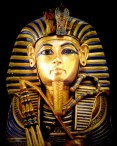
 Depending on how one examines the mirror/ankh, this ‘forest’ could metaphorically reflect the prophesied 400-year wilderness period [Genesis 15: 13-14] since enslaved Africans first set foot in America. The timing of Black Panther‘s release, T’Challa’s mirrored visual of King Tut’Ankh’Amun’s crossed crook and flail which are symbols of the biblically-mirrored Great Shepherd – reflects this larger, multi-layered Savior narrative…
  A true visionary, Ryan Coogler re-links the cultural elements while critiquing the European world’s appropriations, e.g. through Eric Killmonger’s retort to the British Museum director: “How do you think your ancestors got these? Do you think they paid a fair price? Or did they take it… like they took everything else?”
Now, as the “KING TUT: Treasures of the Golden Pharaoh” exhibition moves on from America for the last time, I can’t help wondering what happened to the King’s priceless mirror/looking glass…?
 May this ‘Year of Return’ reawaken humanity to its best reflection and most magnificent Heaven-on-Earth manifestations…
***
NEWS: Egypt seeks Interpol help to retrieve Tutankhamun bust sold in UK
RELATED: Westminster Abbey stops Ethiopian priests visiting holy tablet. Abbey accused of cultural insensitivity over artefact looted in 1868
“Woyaya” ~ Osibisa & Elephant Art
 Woyaya – the catchy title song of the second album by Osibisa, a London-based Ghanaian and Caribbean Afro-pop band led by Teddy Osei – was released in 1971 and would frequently be heard in various settings throughout 1970-80’s Africa. By the time it was reissued in 2004 along with the self-titled first album [Osibisa], the song had been covered by musicians such as The 5th Dimension & Art Garfunkel [1973]. Wiyaala [click pics for music] provides a 2020 version of the classic in which, for Osibisa fans the uplifting expression “woyaya” has since come to literally mean “we are going…” Read More
Congo Square ~ UbuNtu & the Unbroken Circle
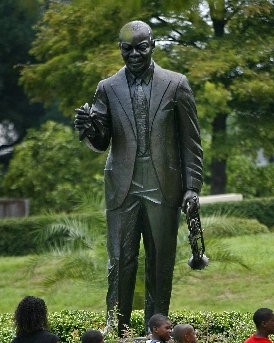 “The bloodlines of all important modern American music can be traced to Congo Square,” musician and trumpeter, Wynton Marsalis once said of this national treasure – the historic birthplace of jazz and Rhythm-‘n’-Blues. Situated in what is now the Louis Armstrong Park in Tremé, the oldest African-American neighborhood in the tricentennial city of New Orleans – at 2.35 acres, today Congo Square measures approximately half of what it was in its heralded 19th century years.
New Orleans, Louisiana [NOLA] is a major US port whose strategic location facilitates the trafficking of commercial goods between the Gulf of Mexico and the Mississippi River system, which historically included trans-Atlantic cargoes of enslaved Africans. Congo Square was a gathering place Read More

 “Towards a Transformation Communication Theory: UbuNtu, Prince, and the Oral-Aesthetic Perspective” was recently published in The Journalist SA. To read the article, click here: http://www.thejournalist.org.za/academic-papers/towards-a-transformation-communication-theory-ubuntu-prince-and-the-oral-aesthetic-perspective

Ascension ~ “Black Orchid”
 “…She has touched the farthest star
Her beauty speaks of what we are
And her freedom makes us free
Her now is in eternity, infinite to all that see
And her dreams have been achieved
Now there is a sound of laughter
Nature sings out her name
For the world to know her fame… ~ Black Orchid ~” [Stevie Wonder – from ‘Journey Through the Secret Life of Plants’]
During the months of July and August, 2018 Mother Earth is responding to an amazing shift in the Harmonics of the Spheres. The Sun’s gravitational pull has aligned to one side of itself all of the planets in the solar system, each with their own unique frequencies. Read More
UbuNtu ~ On Owning Your Masters
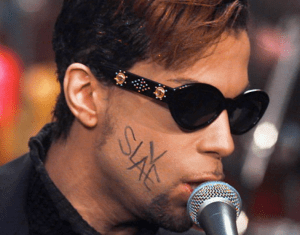 “If you don’t own your masters, your masters own you.” On his B’Earth’Day [June 7th] in 1993, Prince changed his name to the unpronounceable ‘Love Symbol’ of his recently released 14th studio album following disagreements with Warner Brothers [WB], the label which originally signed him in 1977. It was a public act of rebellion against WB’s restrictions over him and his prolific creativity. Likening their contractual relationship to one of indentured servitude or slavery, Prince explained:
Read More
Mazisi Kunene ~ Creative Power
 Mazisi Kunene – freedom fighter, literary icon, Africa’s poet laureate, and South Africa’s first poet laureate – was born in Durban, the “modern-day” province of KwaZulu-Natal on May 12th, 1930. Kunene championed African oral traditions, conveying their inherent value in his writings which were originally in Zulu before being translated into other languages. Read More
Water Bearers & New Age Libations
 “When the moon is in the 7th House… And Jupiter aligns with Mars… Then peace will guide the planets… And love will steer the stars… This is the dawning of the Age of Aquarius…” [Lyrics from “Age of Aquarius” by the 5th Dimension, 1969].
Humanity is said to be currently moving to its new astrological Age – an event which happens roughly every 2,000-plus years. We’re living through a transitional period Read More
Panther Kings, Barkcloth & Milk
 From ancient times to the present day, Africa’s collective imagination has to one degree or another been influenced by the leopard as a symbol of its cultural and spiritual potency. The black panther is the melanistic color variant of leopards in Africa, so perhaps the phenomenal success of the movie of the same name can be used as a current barometer of that potency. North, south, east, west, and diaspora – the leopard is a powerful symbol of African warriors, sages, magicians, priests, gods, goddesses, queens, and kings. In West Africa, sculptures from Ife and Benin portray the leopard as a symbol of wisdom. This statue from ancient North Africa depicting King Tut’Ankh’Amun riding through the underworld on the back Read More
Auset ~ Divine Seeker
 Born in 1803 and orphaned at age 5, Maria W. Stewart was an American domestic servant who became a teacher, journalist, abolitionist, lecturer and women’s rights activist. She urged “daughters of Africa” to reject the negative images of Black womanhood that were/are so pervasive, but to instead possess the power of self-definition – in effect to seek, find, and anchor their Divinity as Goddess Auset. In an 1833 speech, Stewart said: “Like King Solomon, who put neither nail nor hammer to the temple, yet received the praise; so also have the white Americans gained themselves a name, like the names of the great men that are in the earth, whilst in reality we have been their principle foundation and support. We have pursued the shadow, they have obtained the substance; we have performed the labor, they have received the profits; we have planted the vines, they have eaten the fruits of them.”
 The power of images [for good or ill] has been well-known since ancient times in Africa, as evident in the following proverb from the Luxor Temple of Amun-Mut-Montu/Khonsu: “People need images. Lacking them they invent idols. Better then to found the images on realities that lead the true seeker to the source.” The Gods of Khemet created a number of art-for-life’s-sake images that would, when properly looked upon, indeed lead the divine seeker to the source. Knowing the little strength of the angel of the church in Philadelphia, the God of Revelation encodes one of these key images in His instructions: “I know thy works: behold, I have set before thee an open door, and no man can shut it… hold that fast which thou hast, that no man take thy crown…” [Rev 3: 7-12 KJV]
 The Divine Seeker or ‘true seeker’ – from a ‘daughters of Africa’ perspective – is represented in the archetype of Auset, Queen and wife of Khemet’s beloved King Ausar. According to their mythology, the respect Ausar was able to command on earth and in the nether-world as the bringer of civilization made his ‘younger brother’ – a god with pedophilic issues named Seth [Gr.] – so jealous that, in his bloody coup for the throne, Set[h] murdered and cut the king into 14 pieces which he scattered throughout the wilderness to prevent Ausar’s resurrection. In modern terms, Set [god of the wilderness, chaos, violence, foreign oppressors…] is understood to be the adversary who enslaved Africans and stole land and other treasures via slavery, colonialism, apartheid, etc. Thus the ‘wilderness’ is the diaspora where his predatory neo-colonial rule and campaign of chaos and extermination expanded. Auset must search this wilderness for the pieces of her beloved while holding fast to her crown of life which, imaged as the royal throne, represents her shero’s journey and consciousness of who she is.
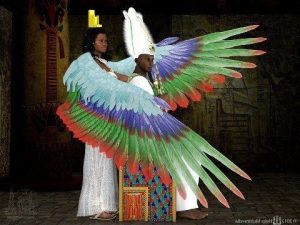 Auset ~ Divine Seeker – shows up as the Shulamite in the Song of Songs, the biblical book attributed to King Solomon who, though featured in the song, is not the true ‘Majesty’ Auset seeks. Famed for wisdom, wealth, and possessing 700 wives and 300 concubines, Solomon represents the unease of one who is trapped in an excess of creature comforts, including his gross objectification of the divine feminine. It’s very clear that the Shulamite [Auset] is critical of the modalities of capitalist exploitation, including occupation & sharecropping which have created Solomon’s trappings of power &, in turn, required military guardians. She says: “Behold his bed, which is Solomon’s; threescore valiant men are about it… They all hold swords, being expert in war: every man hath his sword upon his thigh because of fear in the night.” [SoS 3:7-8 KJV] “Solomon had a vineyard at Baalhamon; he let out the vineyard unto keepers; every one for the fruit thereof was to bring a thousand pieces of silver. My vineyard, which is mine, is before me: thou O Solomon, must have a thousand, and those that keep the fruit thereof two hundred.” [SoS 8:11-12 KJV]
The Song of Songs represents Auset’s mourning as she communicates with and searches for the pieces of her Twin Flame in a ‘wilderness’ [diaspora] caused by the misdeeds of Set, including murder, mutilation, scattering, plunder and rape. Auset’s crown of life, denoting her consciousness, purpose and allegiance, is significantly different from those which are worn in the capitals of Europe – their opulent design and materials conspicuously symbolizing conquest of peoples and control of resources. Without this Africa-centered understanding which would acknowledge Auset’s presiding role in Ausar’s resurrection and return, biblical scholars and translators promote other interpretations even while struggling to explain her divinity and/or justify her existence in ‘their’ holy book. Introducing herself to an audience of the “daughters of Jerusalem,” the Shulamite [Auset] makes clear: “I am black… My beloved is mine, and I am his: he feedeth among the lilies.” [SoS 2:16 KJV]  Local to Upper Khemet – southern source of the Nile River – the lily is also the symbol of resurrection in Khemetic imagery. “I am my beloved’s, and his desire is toward me.” [SoS 7:10 KJV]
Euro-patriarchal translations and commentaries surrounding the Shulamite’s introduction of herself have varied from “I am black and beautiful…” [New Revised Standard Version Catholic Ed] to more sinister/racist ethnic notions – specifically, as Maria W. Stewart pointed out, against Black womanhood:
- “I am black but beautiful…” [Douay-Rheims Bible]
- “I am black but lovely…” [New American Standard Bible 1977]
- “I am black, but comely…” [American KJV; American Std. V; Webster’s Bible Trans; JPS Tanakh 1917; Darby Bible Trans; English Rev. V]
- “I am very dark, but lovely…” [English Standard Version]
- “I am dark but beautiful…” [New Living Translation]
- “I am dark, but lovely…” [New KJV 2000; World English Bible; NET Bible; New Heart English Bible]
 “Dark am I, and comely…” [Young’s Literal Translation]
- “Daughters of Jerusalem, I am dark like the tents of Kedar, yet lovely like the curtains of Solomon…” [Holman Christian Standard Bible]
- “I am dark, O ye daughters of Jerusalem… desirable as the booths of Kedar, as the tents of Solomon…” [Jubilee Bible 2000]
- The word “black” does not necessarily mean that the skin is black, but rather sunburnt, dark brown… the livid or swarthy appearance of one who has suffered long from famine and wretchedness. There is certainly no reason to take the word as an argument for the bride being Pharaoh’s daughter… She has been living in the fields, and is browned with the ruddy health of a country life… The country maiden feels the greatness of the honor, that she is chosen of the king… [Pulpit Commentary]
- …she was “black” in herself through original sin and actual transgression; in her own eyes, through indwelling sin, and many infirmities, spots, and blemishes in life; and in the eyes of the world, through afflictions, persecutions, and reproaches…: “but comely” in the eyes of Christ, called by him his “fair one”, the “fairest among women”, and even “all fair” through his comeliness put upon her, the imputation of his righteousness to her; through the beauties of his holiness upon her; through the sanctifying influences of his Spirit…
 being in a church state, walking in Gospel order… “desirable”(y) to Christ, and to his people. [Gill’s Exposition of the Bible]
Certainly, if such white male interpretations of the black female principal in the Song of Songs prevail, then they should at the very least co-exist with culturally-centered interpretations of the African Queen. One version of the Song of Songs’ backstory – which has received extensive Jewish, Islamic, and Ethiopian elaborations – describes King Solomon being tested with hard questions during his visit from the “Queen of the South” AKA the Queen of Sheba. The Kebra Nagast [“Glory of the Kings”] tells the national saga of Ethiopian Emperors being descendants of King David as a direct outcome of their Queen’s visit with his son Solomon. Followers of the Rastafari movement believe Emperor Haile Selassie I – the last descendant of the Solomonic line to rule Ethiopia [from 1930 to 1974] – to be the Messiah and Lion of the Tribe of Judah.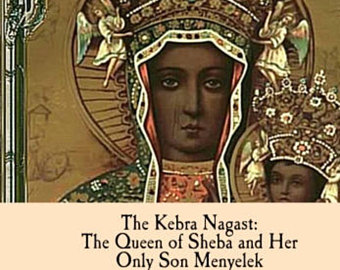 The African Queen’s storied visit is acknowledged in the bible thus: “The queen of the south shall rise up in the judgment with this generation, and shall condemn it: for she came from the uttermost parts of the earth to hear the wisdom of Solomon; and, behold, a greater than Solomon is here.” [Matthew 12:42 & Luke 11:31 KJV]
Told in highly symbolic language, the Song of Songs is itself a riddle worthy of the Queen of Sheba who purportedly used riddles to test Solomon’s wisdom, and to apparently expose the limitations of Euro-patriarchal translations and analyses [above]. Who knows what manner of ‘darkness’ lies in the tents of Kedar or curtains of Solomon to which the Shulamite is being compared by such biblical professionals?! She is not “original sin” in need of white male prescriptions for “salvation.” Nor does she seem particularly desirous of the kind of ‘majesty’ Solomon represents – at least not in my reading of the Song of Songs in which the Shulamite’s mission is that of the African Goddess Auset. As divine seeker who wears a distinct crown of life, it’s critical that Auset be able to distinguish between chaos/shadow/idol versus truth/substance/source as the above-mentioned proverb from the Luxor Temple states. Only in this way does she prove herself worthy of the crown and title bestowed on all true African Queens: “She Who Sees Set and Heru.”
Goddess Auset is…❤❤❤
Panther ~ Black Rite-of-Passage
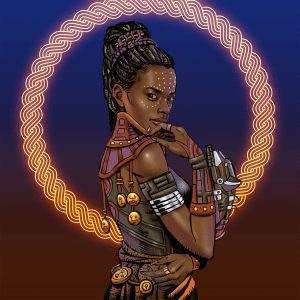 “Great, another broken white boy for us to fix!” One of several funny lines from Black Panther delivered by Shuri in reference to CIA Agent Everett Ross. “What the hail!” My line when I left the theater on President’s Day with mixed feelings about the movie, but mostly about the droplets of ice which had just begun falling from LA’s South Bay skies onto my African head-wrap. Was this a sign? Movie promos had gone hard with Gil Scott Heron’s classic The Revolution Will Not Be Televised, I mused while trying to extract pieces of the odd weather from my son’s fro for inspection. But why not build a strategic alliance between African cousins rather than having T’Challa, in true bourgeois liberal fashion, make a Wakanda charity-case out of Killmonger’s Oakland after the fact? Mom, it’s not your story… Huh?! Read More
Nyabingi ~ Oracle of the Drum & Warrior Queen
 Queen Nyabingi is one of several likely inspirational fonts for Marvel’s comic book renderings of Wakanda’s Dora Milaje, an elite group of female bodyguards who will soon be slaying on the silver screen [2/16/18] in Ryan Coogler’s directorial rendition of Black Panther – the movie. Though fictional, Marvel’s African kingdom of Wakanda is geographically situated around the source of humanity’s genesis, which happens to be where the legendary Nyabingi greatly impacted history as well as our pathways to a pan-African consciousness. A real-life fusion of warrior-queen archetypes that arose in the ancestral Nile River mythologies of Khemet, Goddess Nyabingi’s spirit also lives in the diffusion of beats and flows that birthed hip-hop in today’s diaspora.
Best known for fiercely championing her spiritual, cultural, and political spheres of power through liberation struggles against the Euro-patriarchal rape of her region – rubberstamped at the 1884 Berlin Conference and euphemistically referred to in history books as the “scramble for Africa” – Nyabingi fought hard against her colonial adversaries. In Khemet, this collective adversary was known as Set (god of the wilderness, storms, chaos, violence, famine, illness and foreign oppressors) who was so jealous of Ausar’s richly-endowed kingdom and popular reign that he murdered, mutilated and then scattered pieces of the king’s body [diaspora of enslavement] in order to ascend the throne and sow his dehumanizing brand of chaos in the name of progress…
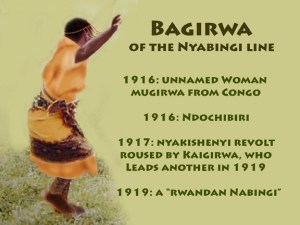
Against this quintessential enemy of Africa and usurper of her resources, Nyabingi also becomes a force of reparations whose shamanic powers are transmitted through oracular healer-priestesses, traditionally called bagirwa. In this role, she is reminiscent of the Khemetic goddess Hathor whose fervent warrior aspect is identified in the leonine goddess Sekhmet. Nyabingi’s shamanic powers also mysteriously link her to Seshat, a Khemetic goddess whose characteristic dress is made of panther skin. Historically, spiritually-endowed women have stood out as leaders of liberation movements throughout the African continent – in part because, like rape, imposed rule has infringed upon the domains of the divine African feminine. Ideological descendants of parasitic shadow-queens such as Victoria [“grand-mother of Europe” 1837-1876] and/or the neo-colonial sychophants who uphold their standing in Africa’s sacred geographies and imagination, are complicit in the continuing rape of humanity’s Mother[land].
Goddess Nyabingi’s legend begins in Mpororo (Uganda’s southwestern region) where Queen Kitami’s rule was disrupted with the theft of her sacred drum by a man named Kamurari. Though Kamurari used the sacred drum to found a dynasty, it was the formidable ancestral presence of Queen Kitami upon whom the reverent title of ‘Nyabingi’ was bestowed by successive generations.  Nyabingi’s compelling presence was deeply acknowledged as she spoke paranormally with and through her chosen female prophets and priestesses from behind the bark-cloth veils they wore.
By the time of Welsh-American journalist and explorer Henry Morton Stanley’s search for the source of the Nile River in the late 1800s on the heels of British explorer David Livingstone’s efforts, Goddess Nyabingi had earned a reputation in the colonial imagination as a “great sorceress.” Her priestesses exercised considerable political power in the Uganda/Rwanda [‘Wakanda’?] borderlands through such acts as collecting tributes from local chiefs. British and German colonials waged war against African women by making alliances with corruptible men, including these same local chiefs. One such example was the alliance they made with Mwame Musinga which led to his treacherous usurping of the throne that the widowed Rwandan queen-mother’s son – like Heru of Khemet through queen-mother Auset – was heir to.
 In 1911, a rebel priestess named Muhumusa formed a spiritually-based military resistance against the wazungu (Europeans) in the name of Nyabingi. So effective was this resistance that the British fought back by passing the 1912 “Witchcraft Act” which threatened to burn the accused at the stake. Muhumusa’s eventual capture in 1913 led to her detention for life which ended with her death in 1945. However, other popular Nyabingi-inspired revolts such as the 1928 Rebellion arose from what a mzungu colonial described as “armed witchcraft dances,” resulting in the killing of colonial-puppet chiefs. “These fanatical women are a curse to the country!” a colonial commissioner was led to declare as the resistance leaders successfully fought and evaded capture.
These warrior-queen-led uprisings were gradually suppressed through a collaborative colonial team effort involving coercive missionaries who would impose Christian baptism onto Africans under threat of punishment as political subversives of the Nyabingi resistance. Eventually, the reparations or healing aspects of the bagirwa’s cultural role regained precedence over the political-warrior dimension of the black freedom struggle.
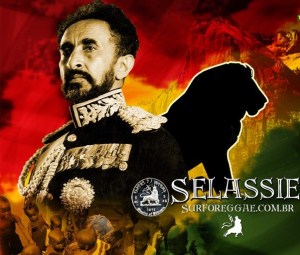 By the 1930s the Nyabingi resistance had been effectively subdued in East Africa. However, it had caught fire in the Jamaican Rastafari movement which began with Europe’s colonization of Africa – AKA ‘Ethiopia’ and/or ‘Zion’ to believers – though the forced exile of enslaved Africans scattered throughout ‘Babylon’ dated back to centuries prior. The Honorable Marcus Mosiah Garvey Jr.’s 1920s prophecy – “Look to Africa where a black king shall be crowned; he shall be your Redeemer” – set the stage for how Jamaicans would come to regard the 1930 coronation of Haile Selassie as Emperor of Ethiopia (a neighboring East African country which had itself successfully resisted European colonization attempts). A member of the Solomonic Dynasty, Selassie was born Tafari Makonnen Woldemikael – hence the Ras-Tafari designation and belief in him as the prophesied messiah, Jah Rastafari or alternatively Lion of the Tribe of Judah. Though His Imperial Majesty, Emperor Haile Selassie, was welcomed with great enthusiasm during his 1966 visit to Jamaica, he was eventually dethroned [9/12/74] back in Ethiopia for reasons which began with the famine his country suffered in 1973.
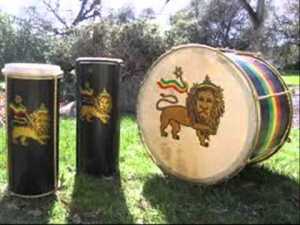 The oldest of the Rastafarian subgroups is Nyabingi – a name which the Jamaican group believe to mean ‘Death to all Oppressors’ – connecting their faith with the African warrior-queen’s powerful spirit of liberation from tyranny. The Rastafari chant ‘bingi’ through prayer, music, dance, and biblical reasonings, calling on nature and the universe of her mystical powers to destroy the wicked reign of ‘Babylon’ – as they believe Jah alone has the right to do – and establish their New Jerusalem or Zion in Africa. In Jamaica, Nyabingi’s rhythmic heartbeat is played by men on a trinity of drums: Thunder (a bass drum also referred to as the “Pope Smasher” or “Vatican Basher”); Funde (the middle drum which maintains the dominant heartbeat and has the least improvisational role); and Akete or Repeater (the smallest, highest pitched drum that plays the most improvisational role as carrier of spirit).
Parallels between Nyabingi‘s prototype sacred drum, and its usage in East Africa can thus be interpreted and understood in the purpose and symbolism of Rastafari expression in the Caribbean. The natural and spiritual forces which connect Nyabingi in the pan-African consciousness also pulse and flow through her waterways: the northbound Nile River from its Great Lakes’ cradle to its ancient flowering in Khemet (known as the Gift of the Nile); and the waterways which map the Atlantic slavery routes with each hurricane that forms off of the West African coast, wreaking destruction at what some consider to be Babylon’s doorstep… “Many waters cannot quench love, neither can the floods drown it…” [SoS 8:7 KJV]
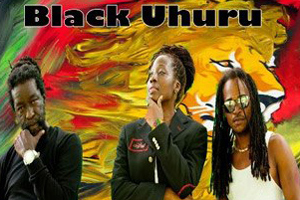 Seminal to the music of Rastafarians, Nyabingi drumming is the same powerful heartbeat pulsing in the reggae stylings of such renowned artists as Bob Marley, Peter Tosh, Black Uhuru, Steel Pulse, Burning Spear, and many others who came up through the faith – rocking locs like the warriors in Kenya’s struggle for uhuru (freedom) against Britain’s colonial rule. Indeed, reggae’s popularity in the 1960s and 70s brought Rasta consciousness to the global masses, which worried those who did not want their liberational cultural faith (mis)appropriated and/or corrupted.
Such reckonings came out of lessons learned from Babylon’s predatory and parasitic dealings against its African host(ess), including: spiritual resources from Khemet having been re-scripted and weaponized through the work of missionaries in their colonial rape or ‘scramble’ for Africa’s natural resources;  the twin-enterprise of slavery through which Africa’s human resources had been stolen and displaced in the so-called New World; as well as the appropriation of her cultural resources. In the Caribbean-Bronx [NY] alchemy which created hip-hop’s seminal heartbeat [through DJs such as Kool Herc], one feels Nyabingi’s continuing struggle to drive that final, fatal stake through the vampire’s collective… heart [???]. Nyabingi reminds us to not be complicit in the rape against the dominion of the divine African feminine, the spoils upon which ‘Babylon’ has built its arrogant and twisted sense of superiority and entitlement. #UbuNtu… #ReparationsNow
❤ ❤ ❤ Power

 Malaika Mutere