
“I Am a Black Man” ~ George Tait (poem)
Andreas Woods aka Kwaw Imana, the mathematics-major Morehouse class of 2000 Valedictorian who would go on to get a Ph.D. in Egyptology, used this moment in the Morehouse spotlight to explain why he rejected the Cecil Rhodes Scholarship for himself. Morehouse is an all-male HBCU. Rhodes’ legacy is that of an avowed white supremacist, reported pedophile, architect of apartheid, & agent of other colonial chaos in Afrika [i.e. ‘Set’ of Kemetic mythology]. Rhodes remains buried in Zimbabwe [colonial ‘Rhodesia’] since his death in 1902, while Britain erected an altar to Rhodes in the form of his statue at Oxford University in 1934! Reciting a poem by George Tait entitled I Am A Black Man, Kwaw Andreas Woods Imana – like Heru [‘Horus/Hero’] in Kemetic mythology – aligns the struggle of Afrika-descended manhood against the knowledge industry’s role in codifying and becoming politically complicit in upholding systemic racism and all of its ills. #RhodesMustFall Read More
Year of Return ~ 2019
PROPHECY?
“…the Lord told Abram, “You can be certain about this: Your descendants will be foreigners in a land that isn’t theirs. They will be slaves there and will be oppressed for 400 years. However, I will judge the nation that they serve, and later they will leave there with many possessions.” [Genesis 15: 13-14 International Standard Version]
PROCEED WITH CAUTION?

BLACK PERSPECTIVES article [click on link below]:
Ghana, France, and the Re-writing of Colonial Narratives
***
ANCESTRAL COUNSEL

Ascension ~ “Black Orchid”
 “…She has touched the farthest star
Her beauty speaks of what we are
And her freedom makes us free
Her now is in eternity, infinite to all that see
And her dreams have been achieved
Now there is a sound of laughter
Nature sings out her name
For the world to know her fame… ~ Black Orchid ~” [Stevie Wonder – from ‘Journey Through the Secret Life of Plants’]
During the months of July and August, 2018 Mother Earth is responding to an amazing shift in the Harmonics of the Spheres. The Sun’s gravitational pull has aligned to one side of itself all of the planets in the solar system, each with their own unique frequencies. Read More
UbuNtu ~ On Owning Your Masters
 “If you don’t own your masters, your masters own you.” On his B’Earth’Day [June 7th] in 1993, Prince changed his name to the unpronounceable ‘Love Symbol’ of his recently released 14th studio album following disagreements with Warner Brothers [WB], the label which originally signed him in 1977. It was a public act of rebellion against WB’s restrictions over him and his prolific creativity. Likening their contractual relationship to one of indentured servitude or slavery, Prince explained:
Read More
Water Bearers & New Age Libations
 “When the moon is in the 7th House… And Jupiter aligns with Mars… Then peace will guide the planets… And love will steer the stars… This is the dawning of the Age of Aquarius…” [Lyrics from “Age of Aquarius” by the 5th Dimension, 1969].
Humanity is said to be currently moving to its new astrological Age – an event which happens roughly every 2,000-plus years. We’re living through a transitional period Read More
Panther ~ Black Rite-of-Passage
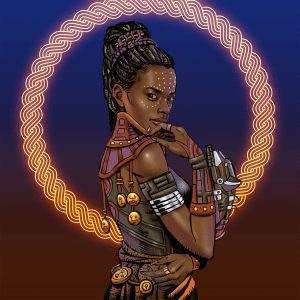 “Great, another broken white boy for us to fix!” One of several funny lines from Black Panther delivered by Shuri in reference to CIA Agent Everett Ross. “What the hail!” My line when I left the theater on President’s Day with mixed feelings about the movie, but mostly about the droplets of ice which had just begun falling from LA’s South Bay skies onto my African head-wrap. Was this a sign? Movie promos had gone hard with Gil Scott Heron’s classic The Revolution Will Not Be Televised, I mused while trying to extract pieces of the odd weather from my son’s fro for inspection. But why not build a strategic alliance between African cousins rather than having T’Challa, in true bourgeois liberal fashion, make a Wakanda charity-case out of Killmonger’s Oakland after the fact? Mom, it’s not your story… Huh?! Read More
Nyabingi ~ Oracle of the Drum & Warrior Queen
 Queen Nyabingi is one of several likely inspirational fonts for Marvel’s comic book renderings of Wakanda’s Dora Milaje, an elite group of female bodyguards who will soon be slaying on the silver screen [2/16/18] in Ryan Coogler’s directorial rendition of Black Panther – the movie. Though fictional, Marvel’s African kingdom of Wakanda is geographically situated around the source of humanity’s genesis, which happens to be where the legendary Nyabingi greatly impacted history as well as our pathways to a pan-African consciousness. A real-life fusion of warrior-queen archetypes that arose in the ancestral Nile River mythologies of Khemet, Goddess Nyabingi’s spirit also lives in the diffusion of beats and flows that birthed hip-hop in today’s diaspora.
Best known for fiercely championing her spiritual, cultural, and political spheres of power through liberation struggles against the Euro-patriarchal rape of her region – rubberstamped at the 1884 Berlin Conference and euphemistically referred to in history books as the “scramble for Africa” – Nyabingi fought hard against her colonial adversaries. In Khemet, this collective adversary was known as Set (god of the wilderness, storms, chaos, violence, famine, illness and foreign oppressors) who was so jealous of Ausar’s richly-endowed kingdom and popular reign that he murdered, mutilated and then scattered pieces of the king’s body [diaspora of enslavement] in order to ascend the throne and sow his dehumanizing brand of chaos in the name of progress…
Against this quintessential enemy of Africa and usurper of her resources, Nyabingi also becomes a force of reparations whose shamanic powers are transmitted through oracular healer-priestesses, traditionally called bagirwa. In this role, she is reminiscent of the Khemetic goddess Hathor whose fervent warrior aspect is identified in the leonine goddess Sekhmet. Nyabingi’s shamanic powers also mysteriously link her to Seshat, a Khemetic goddess whose characteristic dress is made of panther skin. Historically, spiritually-endowed women have stood out as leaders of liberation movements throughout the African continent – in part because, like rape, imposed rule has infringed upon the domains of the divine African feminine. Ideological descendants of parasitic shadow-queens such as Victoria [“grand-mother of Europe” 1837-1876] and/or the neo-colonial sychophants who uphold their standing in Africa’s sacred geographies and imagination, are complicit in the continuing rape of humanity’s Mother[land].
Goddess Nyabingi’s legend begins in Mpororo (Uganda’s southwestern region) where Queen Kitami’s rule was disrupted with the theft of her sacred drum by a man named Kamurari. Though Kamurari used the sacred drum to found a dynasty, it was the formidable ancestral presence of Queen Kitami upon whom the reverent title of ‘Nyabingi’ was bestowed by successive generations.  Nyabingi’s compelling presence was deeply acknowledged as she spoke paranormally with and through her chosen female prophets and priestesses from behind the bark-cloth veils they wore.
By the time of Welsh-American journalist and explorer Henry Morton Stanley’s search for the source of the Nile River in the late 1800s on the heels of British explorer David Livingstone’s efforts, Goddess Nyabingi had earned a reputation in the colonial imagination as a “great sorceress.” Her priestesses exercised considerable political power in the Uganda/Rwanda [‘Wakanda’?] borderlands through such acts as collecting tributes from local chiefs. British and German colonials waged war against African women by making alliances with corruptible men, including these same local chiefs. One such example was the alliance they made with Mwame Musinga which led to his treacherous usurping of the throne that the widowed Rwandan queen-mother’s son – like Heru of Khemet through queen-mother Auset – was heir to.
 In 1911, a rebel priestess named Muhumusa formed a spiritually-based military resistance against the wazungu (Europeans) in the name of Nyabingi. So effective was this resistance that the British fought back by passing the 1912 “Witchcraft Act” which threatened to burn the accused at the stake. Muhumusa’s eventual capture in 1913 led to her detention for life which ended with her death in 1945. However, other popular Nyabingi-inspired revolts such as the 1928 Rebellion arose from what a mzungu colonial described as “armed witchcraft dances,” resulting in the killing of colonial-puppet chiefs. “These fanatical women are a curse to the country!” a colonial commissioner was led to declare as the resistance leaders successfully fought and evaded capture.
These warrior-queen-led uprisings were gradually suppressed through a collaborative colonial team effort involving coercive missionaries who would impose Christian baptism onto Africans under threat of punishment as political subversives of the Nyabingi resistance. Eventually, the reparations or healing aspects of the bagirwa’s cultural role regained precedence over the political-warrior dimension of the black freedom struggle.
 By the 1930s the Nyabingi resistance had been effectively subdued in East Africa. However, it had caught fire in the Jamaican Rastafari movement which began with Europe’s colonization of Africa – AKA ‘Ethiopia’ and/or ‘Zion’ to believers – though the forced exile of enslaved Africans scattered throughout ‘Babylon’ dated back to centuries prior. The Honorable Marcus Mosiah Garvey Jr.’s 1920s prophecy – “Look to Africa where a black king shall be crowned; he shall be your Redeemer” – set the stage for how Jamaicans would come to regard the 1930 coronation of Haile Selassie as Emperor of Ethiopia (a neighboring East African country which had itself successfully resisted European colonization attempts). A member of the Solomonic Dynasty, Selassie was born Tafari Makonnen Woldemikael – hence the Ras-Tafari designation and belief in him as the prophesied messiah, Jah Rastafari or alternatively Lion of the Tribe of Judah. Though His Imperial Majesty, Emperor Haile Selassie, was welcomed with great enthusiasm during his 1966 visit to Jamaica, he was eventually dethroned [9/12/74] back in Ethiopia for reasons which began with the famine his country suffered in 1973.
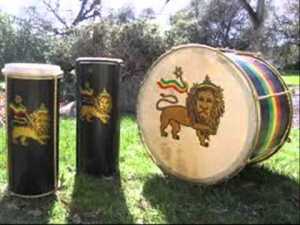 The oldest of the Rastafarian subgroups is Nyabingi – a name which the Jamaican group believe to mean ‘Death to all Oppressors’ – connecting their faith with the African warrior-queen’s powerful spirit of liberation from tyranny. The Rastafari chant ‘bingi’ through prayer, music, dance, and biblical reasonings, calling on nature and the universe of her mystical powers to destroy the wicked reign of ‘Babylon’ – as they believe Jah alone has the right to do – and establish their New Jerusalem or Zion in Africa. In Jamaica, Nyabingi’s rhythmic heartbeat is played by men on a trinity of drums: Thunder (a bass drum also referred to as the “Pope Smasher” or “Vatican Basher”); Funde (the middle drum which maintains the dominant heartbeat and has the least improvisational role); and Akete or Repeater (the smallest, highest pitched drum that plays the most improvisational role as carrier of spirit).
Parallels between Nyabingi‘s prototype sacred drum, and its usage in East Africa can thus be interpreted and understood in the purpose and symbolism of Rastafari expression in the Caribbean. The natural and spiritual forces which connect Nyabingi in the pan-African consciousness also pulse and flow through her waterways: the northbound Nile River from its Great Lakes’ cradle to its ancient flowering in Khemet (known as the Gift of the Nile); and the waterways which map the Atlantic slavery routes with each hurricane that forms off of the West African coast, wreaking destruction at what some consider to be Babylon’s doorstep… “Many waters cannot quench love, neither can the floods drown it…” [SoS 8:7 KJV]
 Seminal to the music of Rastafarians, Nyabingi drumming is the same powerful heartbeat pulsing in the reggae stylings of such renowned artists as Bob Marley, Peter Tosh, Black Uhuru, Steel Pulse, Burning Spear, and many others who came up through the faith – rocking locs like the warriors in Kenya’s struggle for uhuru (freedom) against Britain’s colonial rule. Indeed, reggae’s popularity in the 1960s and 70s brought Rasta consciousness to the global masses, which worried those who did not want their liberational cultural faith (mis)appropriated and/or corrupted.
Such reckonings came out of lessons learned from Babylon’s predatory and parasitic dealings against its African host(ess), including: spiritual resources from Khemet having been re-scripted and weaponized through the work of missionaries in their colonial rape or ‘scramble’ for Africa’s natural resources;  the twin-enterprise of slavery through which Africa’s human resources had been stolen and displaced in the so-called New World; as well as the appropriation of her cultural resources. In the Caribbean-Bronx [NY] alchemy which created hip-hop’s seminal heartbeat [through DJs such as Kool Herc], one feels Nyabingi’s continuing struggle to drive that final, fatal stake through the vampire’s collective… heart [???]. Nyabingi reminds us to not be complicit in the rape against the dominion of the divine African feminine, the spoils upon which ‘Babylon’ has built its arrogant and twisted sense of superiority and entitlement. #UbuNtu… #ReparationsNow
❤ ❤ ❤ Power
Seshat ~ Opener of Heaven’s Door
 In African oral tradition we have a communication concept surrounding the power of the word to generate and/or aesthetize life. In BaNtu culture, this is referred to as Nommo. This same concept in Khemet was referred to as Hekau – “words of power” which were key to the alkhemical authority of god-as-magician. Often viewed as the female version of Djehuti (Khemet’s god of magical arts and foremost scribe of the gods) goddess Seshat accompanied Khemet’s widowed Queen Auset in guarding murdered King Ausar‘s reconstituted and mummified corpse to ensure that he would go on to become God of the afterlife. Read More
Gods, Muses & the Summum Bonum
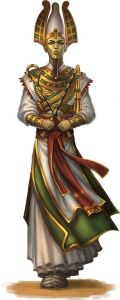 Ausar, god of the afterlife whom many believe holds the seven heavenly stars in his glorified form in the Hunter constellation, was said to have had a great passion for song and dance during his popular reign in Kemet. So much so that he recruited several African Muses to accompany him on a tour to teach the legendary Nile Valley arts of cultivation throughout Asia and Europe, and always had a troupe of musicians back at his court. These Muses became Goddesses in Kemet, but the later Greek conquest of Ausar’s kingdom led to their colonial conversion and subjugation under Apollo Musagete – “Apollo, Leader of the Muses” – of the Olympian world. Read More
HaNtu: Afrofuturism “In the Stone”
~ Posted in honor of African-American Music Appreciation Month, June 2017 ~
 “The artist is meant to put the objects of this world together in such a way that through them you will experience that light, that radiance which is the light of our consciousness and which all things both hide and, when properly looked upon, reveal. The hero journey is one of the universal patterns through which that radiance shows brightly.” [Joseph Campbell, Pathways to Bliss] Read More
Hathor ~ Mansion of Heru

 Hwt-hr is the Kemetic version of Hathor, meaning ‘Mansion of Heru.’ Indeed, as Heru’s divine consort, Hathor is regarded as the sky in which he – as the sun god and “Djedi Sky Walker”/ Dancer – dwells. Hathor is worshipped as goddess of music, dance, beauty, fertility, childbirth, women, children and foreign lands who personifies feminine love, joy, motherhood, and nature in general. Women particularly aspired to embody this deeply loved goddess’s conjoined roles as wife, mother, and lover which gained Hathor the titles of ‘Lady of the House of Jubilation’, as well as ‘The One Who Fills the Sanctuary with Joy’.

Temple of Hathor in Dendera
The depictions detailed in some of the most ancient and venerated temples that were built on and with her African earth testify to goddess Hathor’s similar regard as the Mansion of Heru in the heavens. One of the earliest temples of worship to Hathor was built in Dendera (Upper Kemet) during the first Intermediate period. Inside this particular site, where Hathor was worshipped as ‘Mistress of Dendera’ there are stone reliefs on the walls, which some have argued illustrate that electricity was harnessed in Kemetic times. Originally accessible only to high priest initiates, the accompanying texts warn about the potential abuse of the energy and wisdom depicted on these reliefs. Resembling a light bulb, the Dendera light reliefs alternatively depict the Hermopolis myth of creation in which the lotus flower from the primordial sea of Nun gives birth to the sun god, Atum-Ra – represented by the emerging snake. The surrounding bulb/bubble represents the field of the universe within which this creative process occurs.
Dendera, Hathor‘s main cult site, was where she was considered to be the mother as well as consort of Horus of Edfu. Subsequent temple (and chapel) sites dedicated to Hathor include the Hathor Chapel at the Mortuary Temple of Queen Hatshepsut, and the Temple of Hathor and Ma’at at Deir el-Medina – both in Luxor’s West Bank; the Temple of Hathor at Philae Island, Aswan; and the Temple of Hathor at Timna Valley, Israel. Popular with commoners and royalty alike throughout the ancient world, evidence of devotion to this goddess – before her attributes were absorbed by goddess Auset – also abounds in the Giza Valley Temple of Khafre, as well as in the Luxor Temple of Amun~Mut~Montu/Khonsu (“Triad of Waset“).

Luxor “Temple in Man” – aerial perspective
Built as mansions of the gods, the sacred architecture and décor of Kemetic temples adhere to sound philosophical principles that facilitate humanity’s connections on earth to the higher consciousness of the heavens. Hathor’s goddess aspects inform the design details in the afore-mentioned temples, each a 5-D mansion that speaks in symbol, proportion, volume, harmony, and time – asking us to solve the human-divine puzzle in our inner/understanding and outward exaltations.  Indeed, the Luxor Temple – in which several proverbs surrounding the cardinal concept of “KNOW THY SELF” are inscribed – was built in the idealized proportions of a human frame to help facilitate the discovery that within us are written all the laws of the universe.
Referred to as the “Temple in Man,” the Luxor Temple – constructed circa 1400BCE – is sectioned out (see aerial perspective above) in R.A. Schwaller de Lubicz’s research to correlate architecturally with our human anatomy (see book cover right).  Among the many fascinating details that are brought to light is the scene illustrated within the ‘throat’ area of Luxor Temple’s architectural interiors depicting a special communication taking place between Amun and his consort, goddess Mut. The surrounding transcriptions indicate that in this conversation Amun is informing his beloved that she will give birth to the divine king. This declaration by Amun [1350 BCE] was appropriated in much later biblical accounts of the “Annunciation” in which an angel (“Gabriel”) announces that a virgin (“Mary”) will conceive and become the mother of a divine savior (“Jesus”) who is the son of God.
  Christianity’s version thus recast and rescripted this and other key details of the Nativity play from the original mythology inscribed in the Luxor Temple. Though Khonsu is the son of the Triad of Waset, it’s Heru in the related African Trinity who plays the role of “savior” in original mythologies.
The Hypostyle Hall (pictured above) – the ‘lung’/moon section in the Luxor Temple per Schwaller’s architectural reading – is designed to represent the papyrus swamp in the same mythology where goddess Hathor safeguards and nourishes the child Heru until he comes of age to avenge his father Ausar’s murder against evil Set and restore the throne of Kemet to him (Heru) as Ausar’s rightful heir.  Schwaller’s research of the sacred architecture and lessons also reveal that the architectural design elements of later Christian Coptic churches were appropriated from the section of this same magnificent Luxor Temple that correlates to the ‘heart’/sun.
Hathor’s Temple at Dendera, referred to as the “Womb of Time” is where her birthday is celebrated on the day Sopdet (‘Sirius’ in Greek) first rises in the sky, heralding the annual inundation of the Nile = the New Year. As the “Sovereign/Lady of the Stars,” Hathor was the ultimate sky goddess whose priestesses and priests sang, danced, and entertained in their rituals of worship to her.  The architectural details and décor of this ancient Dendera temple immortalize Hathor as the Sky Mansion of Heru… Goddess of Fertility… and Goddess of Music… among other attributes. The temple columns which stand on the earth (constituted by the floor) and hold aloft the skies (regarded in the ceiling) represent the shaft of the sistrum – Hathor’s celebratory musical instrument.

Offering of SYSTRUMS to Hathor
The face of Hathor as Fertility Goddess displayed at the top of each column is designed to represent the female creative organ of the uterus in its triangular shape, with the elongated ears evident as the fallopian tubes. Because of the ways in which dance and sexuality incarnated in Hathor, she became known by other epithets such as Lady of the Vulva and Hand of God. As such, Hathor‘s attributes as the divine feminine correlate with the dynamics of oral tradition in the organic drama through which life comes into being from an Africa-centered perspective. Heru – her masculine consort in this existential drama – does his share in holding up the skies of Heaven, as illustrated in the ceiling decor of Hathor‘s Temple, aka the earthly Mansion of Heru at Dendera: One of several hymns to Hathor performed at this Dendera Temple says: “Thou art the Mistress of Jubilation, the Queen of the Dance, the Mistress of Music, the Queen of the Harp Playing, the Lady of the Choral Dance, the Queen of Wreath Weaving, the Mistress of Inebriety Without End.”

Historic renderings of goddess Hathor often depict her in the image of a cow, the sun disc and uraeus (rearing cobra emblem of divine authority) within its subtending horns acting symbolically to clarify her significance and status. However despite her legendary popularity and importance, Hathor is a prime example of how the Kemetic tradition merges deities over time in order to advance or evolve their complementary mythologies. She herself supplanted Bat, a cow-goddess representing the source of nourishment; and became interchangeable with cat-goddess Bast (goddess of music, dance, joy, protection, family and love).
 As a spiritual metaphor, the cow represents the Milky Way, the heavenly configuration of the Nile River that was so essential to the existence and sustainment of the sacred wisdom and philosophical belief systems that evolved within the Ma’atrix of Africa’s Nile Valley. Hathor‘s “Celestial Nurse” role as mother/giver and nurturer of life to Heru and her association with the Milky Way over time became attributed to Auset. Renderings of Hathor wearing a cow-horned crown while holding the suckling infant Heru on her lap thus became interpreted as Auset – wife of Ausar and mother of Heru – which were later supplanted by Christian iconography and its appropriated mythologies.
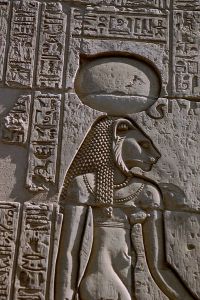 Auset is said to be the more merciful goddess, whereas Hathor pursues her goals with a single-minded fervor which – when driven by anger – turns her into the leonine warrior goddess, Sekhmet. As such Hathor becomes the Eye of Re – defender of the sun god to whom, in this form, she is regarded as daughter/mother/ consort – preventing chaos from agents of disorder that threaten his rule… her aspect as Ma’at. It is an iteration of the epic saga of Heru in the restoration of righteous authority and order against the evil and chaos of usurper Set. The ancient Book of the Heavenly Cow tells a story about Sekhmet‘s role at the end of the 28-year war that was fought to unify Upper and Lower Kemet and begin the Middle Kingdom era. In this story it is said that so strong was Sekhmet’s blood-lust during her rage-fueled rampage of slaughter against enemies of Re in the Lower Kingdom that the only way she could be made to stop and return to her gentle form as Hathor was by becoming intoxicated from drinking vast amounts of crimson-colored beer that Re poured on the ground to resemble blood.
Central to Kemetic concepts of the female divinity, the Eye of Re was associated with other goddesses, notably Mut – consort to Amun – who’d take on the typical leonine form in this warrior aspect. Since each of the falcon-headed god Heru‘s eyes were respectively equated with the sun and the moon, his solar (right) eye was the one referred to as the Eye of Re, whereas the lunar (left) one was referred to as the Eye of Heru.  Hathor – “Lady of the southern Sycamore” – is said to have used milk from her sacred tree to restore sight to Heru‘s lunar eye after his legendary bruising battle against Set. “His eyes are as the eyes of doves by the rivers of waters, washed with milk and fitly set.” [KJV – SoS 5:12] Similar to Mut in regard to her status as a tree deity (thus Djed pillar) Hathor was sometimes depicted handing out water to the deceased from her Sycamore. As ‘Lady of the West’ (the direction of the setting sun) Hathor was said to protect and assist the dead in their final journey, and often appears on sarcophagi.
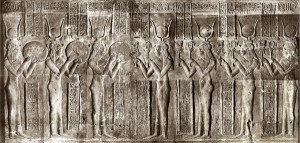 Associated with dream-interpretation, fate and prophetic knowledge of every person’s life from birth through their death, protection from evil, and help in matters of love, this divine-feminine Mansion of Heru/ Hero may thus also thus be regarded as Hathor of the Ma’atrix = ‘Goddess of the S/Hero’s Journey’ which enjoins each and every one of us in our lifetimes. The ‘Seven Hathors’ (illustrated) – worshipped in seven cities, including Waset where the triad of Amun~Mut~Khonsu was preeminent –
  are said to be present in human form at the birth of a child, but are accompanied by the sky-bull in their cow form in a funerary context where they are believed to nourish and protect the deceased from harm.
“Nitakungojea Milele” ♥ …RIP Al Jarreau (3/12/40 ~ 2/12/17)
Heru ~ Djedi Sky Walker
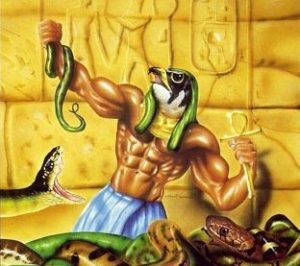 “Sky God… God of Hunting… Warrior God… Lord of the Horizon… Divine Falcon… He who came forth from Hapi [Africa’s Nile God]… Dweller in Sopdet [Star of Auset]… God of Kingship… Heir of his Father…” are some of the epithets ascribed to Heru, one of Africa’s most storied gods of salvation. Heru‘s hunting prowess is represented in the falcon or hawk whose right and left eyes respectively denote the sun and moon
 ; and who is said to hold the stars in his speckled feathers as his wings create the wind. The circumstances of Heru’s placement in the Holy Trinity which includes Ausar (his father) and Auset (his mother), and his triumphant role in the battle against evil [Set], make him a model for saviors, heroes, and the super-heroes of story, religion, comic-book universes and their silver screen adaptations. The Kemetic Trinity itself may conceivably be connected to the older African Triad of Waset, namely Amun~Mut~Montu/Khonsu.
  Among his many epithets, Amun (“Amen” in prayer) – Lord of All, whose name means “invisible… mysterious of form… the hidden one” who encompasses every aspect of creation – is referred to as “Eldest of the Sky.” [Papyrus Boulaq 17]
The classic battle of “good versus evil” evolves in the immortal myth of Heru versus his “uncle” Set who not only murders beloved King Ausar in order to usurp the throne of Kemet, but mutilates Ausar’s body and scatters its pieces throughout the wilderness (diaspora). Auset roams the wilderness in search of her husband’s 14 pieces which she reassembles and mummifies, minus his penis which remains missing.  However, through the summoning of magical powers, Ausar is enabled to posthumously impregnate Auset with the seed of their son, Heru. (In some versions, Heru is interpreted as the newborn sun rising “from a lotus bloom that expanded its leaves on the breast of the primordial deep.”) Ausar’s “resurrection” creates Auset’s “virgin birth” of “savior” Heru who, in his later years goes on to avenge his father’s murder and challenge Set for the throne of Kemet.
  This epic struggle – which additionally exposes the pedophilic proclivities through which Set tried to overcome his “nephew” – is eventually settled before a Council of Elder Gods in favor of Heru as Kemet’s rightful heir and victor of the battle over evil/chaos.
Over the millennia Set became associated with the Hyksos – hostile foreign invaders from the desert or wilderness who enslaved the native men along with their wives and children. Thought to have the white skin and red hair attributed to his followers, Set’s links to Africa’s parched, infertile desert (the “red place”) expanded to represent all deserts and foreign lands.  His glyph appears in the words for “turmoil… confusion… illness… storm… and rage” which eventually cemented Set’s negative brand as god of the desert, storms, disorder/chaos, violence and foreign oppressors (enslavers/colonizers/apartheid architects, etc.).
 While Heru represented Lower Kemet, his eventual victory over Set gave him the distinction of being a unification god, which is symbolized in the pschent crown the avenging hero/Heru is typically portrayed wearing. The deshret (red portion of the crown) represents the North/Lower Kemet, while the hedjet (white portion) represents South/Upper Kemet. Sema-tawy – an expression meaning “Uniter of the Two Lands” – was an alternative depiction, showing the human trachea (like the Nile) unifying Kemet with the entwined plants of the papyrus (native to Lower Kemet) and lily/lotus blossom (native to Upper Kemet).
  Heru, the falcon sky god, was worshipped at KomOmbo in a temple which was also dedicated to Sobek, a crocodile god associated with Set. There are depictions of Heru alternatively wearing the double feather crown that is characteristically associated with Amun – “Eldest of the Sky” – who in his own right also holds the title “Lord of the Throne (Nst) of the Two Lands.” [Papyrus Boulaq 17]
A proverb from the Luxor Temple of Amun~Mut~Khonsu adjures: “Popular beliefs on essential matters must be examined in order to discover the original thought.” Several scholars have discussed at length the relationships one finds between original African mythology and the later popular beliefs of Christianity, including those mentioned above (“holy trinity… resurrection… virgin birth… savior…”) and Heru’s association with the Messianic star of Auset – Sopdet – which heralds the annual flooding of the Nile. A related proverb from the Luxor Temple advises: “Men need images. Lacking them they invent idols. Better then to found the images on realities that lead the true seeker to the source” …

Oscar (Hollywood 1929-)/Ptah (Kemet 760BCE-)
One only need look at the Oscar statue to begin to understand how deeply bound the American image industry is to African Gods and their mythologies. So it’s unfortunate that the silver screen has become a showcase for white self-idolatry with scripts that continue this type of exploitation and cultural imperialism including (i) Nikolaj Coster-Waldau as Heru in the 2016 release of Director Alex Proyas’ vision of Gods of Egypt; (ii) Superman – as some would argue (ref: “Atlanta Black Star” article); and of course (iii) Star Wars:
Djedi were Masters of the Force in Kemet (ancient Egypt), magician priests who guarded powerful kings and their immortality. As with Star Wars, “Holy Grail” legends such as those of King Arthur and his Knights of the Round Table evolved much, much later out of these Djedi histories from Kemet. The Djed – meaning pillar or backbone – is one of the symbols carried by kings of Kemet which is key to their immortality. The ‘dj’ root of the word denotes the serpent which has been awakened by the Djedi, and is raised up through the pillar to the crown of the Djedi King. Harnessing the Force for this inner ascension thus distinguished the Djedi, enabling successful initiates to advance in their abilities to access supernatural powers for use in feats of magic, overcoming enemies, healing, teleportation, resurrection, and so on.  The ultimate Djedi Master of the Force is said to be Djehuti (“Thoth” in the later Greek appropriations), Chief Scribe to the Gods of Kemet who himself mentored Heru and intervened in his struggles against Set. Djehuti is consort to Ma’at – goddess who represents the Kemetic concept of truth, balance, order, harmony and justice. It was Ma’at who is said to have decreed Heru as the rightful ruler of Kemet over Set, thus dispensing one of her main roles of defending the order of the universe from the chaos of the dark side.
In the alternate Star Wars universe, the battle between good and evil is waged by the “Jedi”/Djedi knights such as Luke Skywalker against the “Sith”/Set forces of darkness. Thus, some would extrapolate that this highly popular franchise is just another example of how Tinseltown’s “entertainment”-industry elite itself, and through such practices, acts as Set – profiting while programming consumer masses for dysfunction in its questionable custodianship of Africa’s cultural and spiritual resources; at the very least by not attributing proper credit, but also with its racist circumscriptions of “black” versus “white” roles…
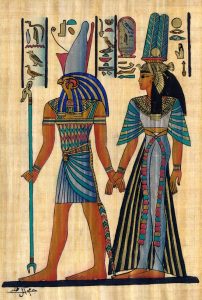 Enter the “True Seeker” mentioned in the proverb – AKA the African Djed-I Queen! (Note: the linked post discusses the bond between the Djed pillar and one of the African Queen’s roles.) As yet another proverb from the Luxor Temple of Amun~Mut~Khonsu states: “A phenomenon always arises from the interaction of complementarity. If you want something, look for the complement that will elicit it. Set causes Heru. Heru redeems Set.” Queens of the First Dynasty bore the title “She Who Sees Heru and Set” in relation to the Djed-I Queen’s ideal consort being worthy as Heru (in His divine-masculine/higher nature) who has overcome Set (his chaos-inducing dysfunctional-shadow/lower nature). As discussed more fully in my post “Pyramid Wisdom & Story” – which offers an interpretation of the “true love written in the stone” [EW&F] (see music video link, plus interior design of the Great Pyramid of Giza below) – the archetypes actively embodied in the Djed-I Queen’s Heru/Hero are: (i) King; (ii) Warrior; (iii) Magician; & (iv) Lover.
 Heru – as “God of Kingship” and African Hero – is the Djedi Sky Walker represented in the Hunter/Warrior constellation that the shaft in the King’s Chamber of the Great Pyramid of Giza points to. In Her aspect as Auset, the Djed-I Queen is the “Divine Mourner” and “True Seeker” who searches through the wilderness for Her true beloved – as Heru, in turn, hunts for His Djed-I Queen. She partners in the reparation of their Royal and Holy consortium, which weakens Set the stronger it gets. In Her aspect of Ma’at, the Djed-I Queen has discovered Her Truth and the Balance that must exist with Her beloved (Heru in His aspect of Djehuti ~ Magician & Scribe to the Gods) that will instill the Heavenly Order which prevents the universe from returning to a state of chaos (represented by “evil” Set). Her Lover – the Djedi King – is her Amun/Amen, and perhaps their Heru–S/Hero journey is the quintessential telling of the epic and timeless story of the Love-of-Power [Set] being overcome by UBUNTU ~ the Power-of-Love ❤ ❤ ❤

 Malaika Mutere