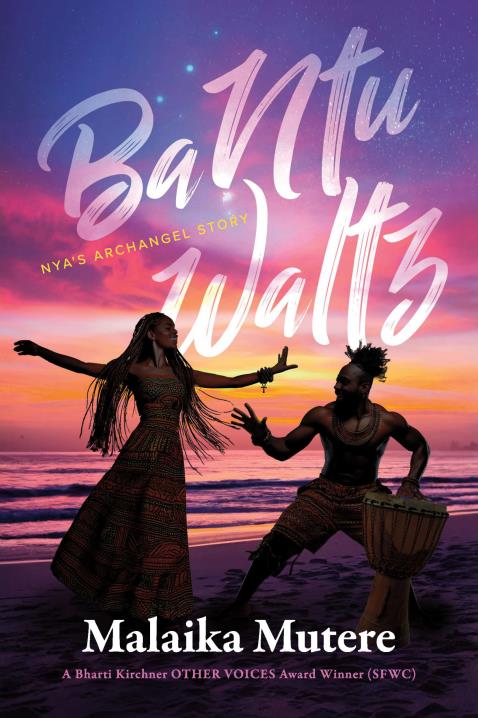
“BaNtu Waltz ~ Nya’s Archangel Story”

Book Cover Image

Embers of 5D

SKIPPER’S LOG / ANCESTRAL ENTRY DATE: December 13, 2017 December 22, 2024 [Gregorian]

❄️Happy Solstice!❄️

It’s that moment when the Sun (Latin: “sol”) stands still (Latin: “sistere”) in The Eternal Dance with Mother Earth before reversing direction on Her Dancefloor. At this (December 22nd, 2023) point in the choreography of these literal Life Partners, the Sun has reached its annual southern limit over Earth‘s Tropic of Capricorn, marking a shift in Earth’s seasons which registers in the Northern Hemisphere as the shortest day and longest night of the year. This Winter Solstice event is a death-of-sorts, signaling the start of a 3-day transitional mourning period which ends on Dec 25th when it then becomes for some a time to celebrate the “Resurrection or Birth of the Sun.” According to scholars, Christianity personified this solar activity by creating a Euro-patriarchal Savior-figure with a formal “Christmas” birth-date that corresponds to the climax of this natural annual event [see “Caesar’s Messiah…” link @43:00]. Read More

The Beautyful Ones…

The Beautyful Ones Are Not Yet Born, Ayi Kwei Armah’s debut novel (published in 1968), owes its title to the misspelled inscription on a bus in Ghana where the story is set. It opens during the final months in 1965 of President Kwame Nkrumah’s rule as Ghana’s first post-colonial president, and closes with the coup that ousted him on February 24th, 1966. This period in Ghana’s history is filled with rampant poverty; overdependence on foreign capital and goods; corruption & bribery as the order of business; and other ills that have plagued Africa’s countries which followed Ghana into independence – all without the needed systemic changes that would mitigate the stagnation and disillusionment of Africans who’d only become inevitably ensnared in parasitic neo-colonial arrangements. Immersing his characters in putrid filth, rottenness, dirt, and scatological imagery as he airs out Ghana’s post-independence laundry through story, Armah leads the reader to the judgment on the novel’s final page – the misspelled bus inscription that becomes its title.

The Beautyful Ones Are Not Yet Born was widely praised but also criticized, most notably by Nigerian novelist Chinua Achebe, who writes: Armah is clearly an alienated writer complete with all the symptoms. Unfortunately, Ghana is not a modern existentialist country. It is just a Western African state struggling to become a nation. So there is enormous distance between Armah and Ghana.… A man is never more defeated than when he is running away from himself. 

AUSAR [Osiris] ~ The ‘Beautyful’ One

In his preface to a new edition of the novel published by Per Ankh, Ayi Kwei Armah himself makes note of the criticism his novel received: “Much of it focused on [my] perceived artistry. There was a tendency …to contrast this supposed authorial virtuosity with the novel’s subject matter, rather inaccurately summed up as the pervasive negativity of the human condition in Africa. This bias didn’t surprise me, and I assumed it would take little time for some careful scholar to balance it by zooming in on the conceptual content of the title, which I think expresses the meaning of the text as accurately as any title can. It is a matter of some bafflement to me, therefore, that to date, as far as I know, no critical assessment has actually gone to that thematic core: the provenance of the concept and image of the beautyful ones. The phrase ‘The Beautiful One’ is ancient, at least 5,000 years old. To professional Egyptologists, it is a praise name for a central figure in Ancient Egyptian culture, the dismembered and remembered Osiris, a sorrowful reminder of our human vulnerability to division, fragmentation and degeneration, and at the same time a symbol of our equally human capacity for unity, cooperative action, and creative regeneration…

By the time I wrote the novel my impressions of Osiris, though still relatively disorganized, had evolved to the point where I was ready to recognize the image as a powerful artistic icon. Here, in mythic form, was the essence of active, innovative human intelligence acting as a prime motive force for social management. I have yet to come across an earlier, or more attractive image for the urge to positive social change.”

NEFERTITI ~ The Beautiful Woman Has Come’

For conceptual context, Armah could well have used another renowned ancient Egyptian figure whose name means the beautiful woman has come.” Queen Nefertiti, alongside her husband Pharaoh Akhenaten, established the monotheistic cult of Aten-worship – a ‘new world order’ in 14th century BCE which Akhenaten led from his worship center of Amarna. Egyptian artwork during Aten’s Amarna Period was also radically different from its predecessors. The imposed reforms of traditional culture and spirituality resulted in Aten’s legacy becoming that of Egypt’s despised ‘heretic king.’ Aten’s son and eventual successor, Tut’Ankh’Amun (formerly Tut’Ankh’Aten – meaning “the living image of Aten”) restored ancient Egypt’s cultural traditions around Amun and returned its worship center to Uaset (Gr. ‘Thebes’) during his reign. Hence his name change to Tut’Ankh’Amun.

The Nefertiti Bust – believed to have been crafted in 1345 BCE by Thutmose because it was found in his workshop in Amarna by German Ludwig Borchardt’s archaeological team in 1912 – has become one of the most copied works and iconic symbols of feminine beauty, which most associate with Egypt. Kept at various German locations since its “discovery,” the Nefertiti Bust is currently on display at the original  pre-WW2 display site of Neues Museum in Berlin. Germany, like most former colonial powers which have profited greatly off their stolen African artefacts, continues to resist Egyptian demands (since 1924) for the repatriation of Egypt’s Mona Lisa, as it were – the bust of Egypt’s ‘beautiful woman…’ Nefertiti.

In relation to Armah’s musings on Osiris/Ausar‘s symbolic relevance to Africa-writ-large, in ancient Egypt a true Queen [Auset] was said to be “She who sees Set and Heru.” Set – god of foreign oppression, chaos, violence, perversion, illness… – who usurped Egypt’s Heaven-on-Earth throne through murdering and dismembering Ausar, and then scattering his pieces [African diaspora] is evident from the predatory Eurocentric divide-&-conquer playbook which creates the parasitic matrix systems humanity experiences as slavery, (neo)colonialism, apartheid… through misappropriation & predatory control of Africa’s sovereign resources. Heru – Ausar & Auset’s posthumously-conceived son who avenges his father by defeating Set & restoring Heaven-on-Earth – is apparent in the post-Amarna role of regeneration Tut’Ankh’Amun played out of his allegiance to Amun, not Aten… #Sankofa.

FATHIA HALIM RITZK NKRUMAH ~ A ‘Beautyful’ First Lady of Ghana

The links between Egypt and Ghana go further than a background concept in Ayi Kwei Armah’s mythologically-based authorial imaginings. Fathia Halim Ritzk – a Coptic Egyptian who’d taught French prior to taking a job at a bank in Cairo – became First Lady of a newly independent Ghana when she married Kwame Nkrumah on New Year’s Eve 1957-58. According to published reports, Nkrumah – who succeeded Queen Elizabeth II on March 7, 1957 as ruler of Ghana – had set out to find himself a Christian wife from Egypt through his friend, Alhaji Saleh Said Sinare – one of the first Ghanaians to study in Egypt. Fathia was chosen out of five finalists. Despite her mother’s refusal to bless their union, Fathia’s marriage to Nkrumah took place at Christianborg Castle upon her arrival in Accra, Ghana. Unmoved by Nkrumah’s pan-African vision & bona-fides, Fathia’s mother – whose son had left Egypt with an English wife – had been reluctant to see another of her five children marrying a foreigner and leaving the country. Fathia returned to Cairo with their 3 children after the western-sponsored coup d’état that ousted Nkrumah on February 24, 1966. Nkrumah died in 1972 in Bucharest, Romania. Fathia died in Cairo in 2007. Both husband and wife lie buried side by side at the Kwame Nkrumah Memorial Park in Ghana.

BRANFORD MARSALIS ~ The Beautyful Ones Are Not Yet Born’

Titled after Ayi Kwei Armah’s book, The Beautyful Ones Are Not Yet Born is also a 1991 jazz album by Branford Marsalis (tenor and soprano sax player) who leads a trio with Jeff “Tain” Watts and Robert Hurst. The Beautyful Ones Are Not Yet Born is the 2nd track on the album which peaked at #3 on the Top Jazz Albums chart. Wynton Marsalis, Branford’s trumpet-playing brother, makes a guest appearance on the album’s 4th track, Cain and Abel. Hailing from New Orleans Louisiana, the Marsalis brothers are world-renowned members of their multi-generational ‘First Family of Jazz.’ Wynton is often quoted as saying: “The bloodlines of all important modern American music can be traced to Congo Square.” 

Congo Square in New Orleans is a cultural and spiritual intersection which, like nearby Angola… was named after countries of origin of Louisiana’s predominant enslaved African population. Custodians of BaNtu oral-aesthetic traditions navigated this foreign space in ways that generated musical conversations (jazz, rhythm-&-blues, etc.). Guided by UbuNtuthe unity-conscious cultural philosophy which says “I am, because we are…” – African oral-aesthetic traditions became one of the greatest civilizing forces in America. BaNtu aesthetic quality or beauty – called KuNtu – is judged by how well cultural expression meets its art-for-life’s-sake cultural mandate towards the collective. In contrast to Manifest Destiny &/or Western Exceptionalism which were used to justify the enterprises of slavery, (neo)colonialism, apartheid, etc. – the so-called “white man’s burden” – UbuNtu has endured as a counteractive Africa-centered guiding & humanizing force.

PRINCE ~ The Beautiful Ones’

In a scene from his 1984 movie, Purple Rain, Prince delivered an unforgettable performance of a song titled The Beautiful Ones. Apparently the artist had already settled on the same as a title for his biography which he’d begun working on with writer and lifelong fan, Dan Piepenbring. Through the telling of Prince’s story, it seems the greater vision was for the co-written project to inspire and help cultivate a society of beautiful ones… be a “handbook for the brilliant community”… a how-to guide for black -musicians, -creatives, -collective ownership, -freedom… an authentic voice against racism, elitism, etc. & for positive social reform. An ancient proverb from Ipet-Resyt (the “southern sanctuary” and temple of Amun~Mut) says: When the governing class isn’t chosen for quality it is chosen for material wealth: this always means decadence, the lowest stage a society can reach. A fragmented version of Prince’s The Beautiful Ones was posthumously published and released exactly 5 years ago – on October 29th, 2019. So much has evolved on the community’s global streets since then…

Perhaps, as Ayi Kwei Armah suggests, a resurrected Ausar is rising out of the Babylonian ashes of a false ‘elite’ matrix through the Collective Ascension of a fragmented/degenerated Human Consciousness – and, like the proverbial Phoenix of old… The Beautyful Ones Are Now Being Reborn… Sankofa UbuNtu

Purple Rain~Happy 40th!!!

SKIPPER’S LOG / ANCESTRAL ENTRY DATE: June 18, 2016 June 25, 2024 [Gregorian]

Purple Rain, Prince’s 6th studio album, was released 40 years ago on June 25th, 1984
“When there’s blood in the sky – red and blue = purple… Purple Rain pertains to the end of the world and being with the one you love and letting your faith/god guide you through the Purple Rain.”             
[Prince’s quote on the meaning of his song]

☮︎🕺🏿🎶☔ UbuNtu Purple REIGN#YesWeCodeVIVA GEN Z!!! 👑 Let No one take THY CROWN 🌞Let There BE LIGHT!🌞🎶💜💃🏿 c𝄞b♯🕊️

“Every man must act in the Rhythm of His Time. Such is Wisdom… People need images. Lacking them they invent idols. Better then to found the images on realities that lead the True Seeker to the Source… In every vital activity, it is the Path/Free-quency that matters.~Proverbs from Ipet-Resyt [“Southern Sanctuary”] of God Amun & Goddess Mut
💜 ❤ UbuNtu 💜Blessed Be ❤ 💜

1920457_597059083716167_1955526539_n

Divine Motherhood ~ “The Womb of Time”

SKIPPER’S LOG / ANCESTRAL ENTRY DATE: May 4, 2016 May 12, 2024 [Gregorian]

~ “WISDOM HATH BUILT HER HOUSE…” ~ [Pr. 9]

In every vital activity, it is the Path/Free-quency that matters… The seed includes all the possibilities of the Tree. The seed will develop these possibilities, however, only if it receives proper nourishment and corresponding energies from the Sky… A nut doesn’t reveal the Tree it contains… Always watch and follow Nature.” ~Proverbs from Ipet-Resyt [“Southern Sanctuary”] of God Amun & Goddess Mut

 Blessed Be 

A Master’s TKHNology

SKIPPER’S LOG / ANCESTRAL ENTRY DATE: April 13, 2016April 21, 2024 [Gregorian]TKHNology
🪘Don’t get lost in the forest…🪘
“In every vital activity, it is the Path/Freequency that matters… The first concerning the ‘Secrets’: all cognition comes from inside; we are therefore initiated only by ourselves, but the Master gives the keys. The second concerning the ‘Way’: the Seeker has need of a Master to guide them and lift them up when they fall, to lead them back to the right way when they stray… If the Master teaches what is error, the Disciple‘s submission is slavery. If S/HE teaches Truth, this submission is Ennoblement. ~Proverbs from Ipet-Resyt [“Southern Sanctuary”] of God Amun & Goddess Mut
🪘🪘🪘Blessed Be🪘🪘🪘

‘End of the Road’ (?)

💜💜💜 On August 1st of this year [2023] during my vacay in Minneapolis, I treated myself to the VIP Tour of Paisley Park… a complex that snuck up on me en-route during a convo I was enjoying with my Eden Prairie-based SW Prime driver along Highway 5 – part of the 7-mile Chanhassen stretch which MN Governor Tim Walz signed into law as the now renamed Prince Rogers Nelson Memorial Highway. The white-on-purple freeway signage went up 2 days later, on August 3rd. Read More

A Master Drummer & His Healing Path

In Africa it is said that each person has a rhythm to which they alone dance. What I’ve learned about this cultural proposition is there is a journey involved in finding one’s rhythm that will likely take you to unexpected places… the highs, lows, and in-betweens of which depend upon how genuine one is about self-discovery. The question of me/”self” was not going to be answered through academic inquiry, no matter how off-the-beaten-path ethnomusicology may have seemed by the time I had to decide on a graduate program to enroll in. Though I remained clueless about how to respond to the musical call that had compelled me to make my south-west journey from Kenya to the US in the first place, I was grateful that my university gospel choir was a space where I could return to organic call-response flows and break from the academic humdrum of musicology discourse. Many years and countless lessons later I’ve come to appreciate that while this path provided a necessary critical lens on the western knowledge industry, I was being guided step-by-step by a higher universe back to my culturally and spiritually authentic/integrated self… Read More